
Abstract
This study examines the development of creative tourism in Cham villages in An Giang province. It first systematizes the network of nine Cham villages and provides an in-depth description of creative tourism activities in two well-known villages - Chau Phong and Da Phuoc. Despite their rich cultural heritage and strong community hospitality, creative tourism in these villages remains limited by a narrow range of experiential activities and a shortage of homestay accommodation services. The findings highlight opportunities to expand and diversify co-creation activities in Cham villages, particularly in traditional weaving and Cham cuisine. The study proposes a set of solutions aimed at enhancing visitor engagement, strengthening community participation, and advancing the sustainable development of creative tourism in Cham communities.
Keywords: creative tourism, Cham villages, Cham bocade weaving.
1. Introduction
Creative tourism is an advanced type of cultural tourism, defined as one that offers an opportunity to develop a visitor's creative potential through active participation in cultural learning experiences and the character of a destination (Richards & Raymond, 2000). This type emphasizes the active participation and co-creation of tourists and is recognized as a method to help improve competitiveness and contribute to sustainable tourism development (Pham Trung Luong, 2025). An Giang province has nine Cham villages with rich indigenous cultural treasures, such as cathedral architecture, brocade weaving, and typical cuisine, creating a solid foundation for the development of creative tourism. However, tourism here is facing significant challenges in terms of the monotony of experiential products and the lack of homestay accommodation services (Hanh Chau, 2024). Therefore, this study raises the question: How to develop creative tourism effectively in Cham villages in An Giang to maximize the potential of indigenous culture. To solve the above problem, the study focuses on analyzing the current situation of activities in 2 famous Cham villages, Chau Phong and Da Phuoc, assessing the advantages and limitations, and thereby proposing strategic solutions to further develop the type of creative tourism for the system of Cham villages in An Giang.
2. Theoretical framework
2.1 The concept of "creative tourism"
The concept of creative tourism was first defined by professors Greg Richards and Crispin Raymond in 2000: “Creative tourism is a type of tourism that offers visitors the opportunity to develop their creative potential by participating in cultural learning experiences and the characteristics of the destination” (Richards & Raymond, 2000).
According to UNESCO (2006), Creative Tourism is defined more broadly, which emphasizes the participation of tourists in learning and connecting with locals in the destination to create vivid cultural products.
The Organisation for Economic Co-operation and Development (OECD) defines Creative Tourism as creative activities based on learning about the elements that create local cultural values in the process of connecting creators with the community in the destination to create cultural products with meaningful content and experiences (OECD, 2014).
The general definition accepted by many scholars is: Creative Tourism is a type of cultural tourism in which tourists, when participating, will have the opportunity to develop their creative potential and enhance their own experience through interactive activities with the local community at the destination to learn, Learn about indigenous cultural values (Pham Trung Luong, 2025).
2.2. Characteristics of Creative Tourism
Creative tourism is a form of tourism that has emerged in response to visitors’ increasing demand for enriched experiences through interactive engagement with local communities. According to Pham Trung Luong (2025), this type of tourism encompasses the following fundamental characteristics:
Active participation and co-creation
Visitors are encouraged to create local products actively together with indigenous residents, rather than merely observing and passively perceiving local cultural values. Tourists are not only beneficiaries of cultural experiences but also contributors who produce cultural artifacts derived directly from what they encounter. Culturally grounded learning activities provide visitors with opportunities to develop their own creative potential. Creative activities may include painting, sculpture, pottery making, culinary practices, and similar forms of artistic engagement.
Deep interaction with local communities and indigenous cultures
Creative tourism places strong emphasis on interaction with local communities. This process involves visitors connecting with local residents to experience traditional cultural lifestyles, acquire knowledge, and explore indigenous cultural values. Creative tourism products are developed based on the knowledge, lived experiences, and practical skills of local people, reflecting the distinctive cultural identity and characteristics of each region.
Uniqueness and sustainability
Creative tourism enhances destination competitiveness and contributes to sustainable tourism development. Due to their grounding in indigenous knowledge and the unique creativity of each locality, its products are difficult to replicate and offer highly distinctive experiences. Furthermore, creative tourism is not dependent on the “seasonality” of tourism activities, thereby helping to reduce the adverse effects associated with tourism seasonality.
3. Methodology
This study employs a qualitative research design, using a case study approach in the Cham villages of An Giang (Chau Phong and Da Phuoc). Theoretical frameworks on creative tourism are systematically synthesized to establish a foundation for tackling issues associated with the development of creative tourism.
Field surveys were executed via direct observation of creative tourism activities to gather primary data. These data were used to analyze the current situation and evaluate limitations, particularly regarding the monotony of tourism products and the lack of homestay accommodations.
4. Results and discussion
4.1. System of Cham villages
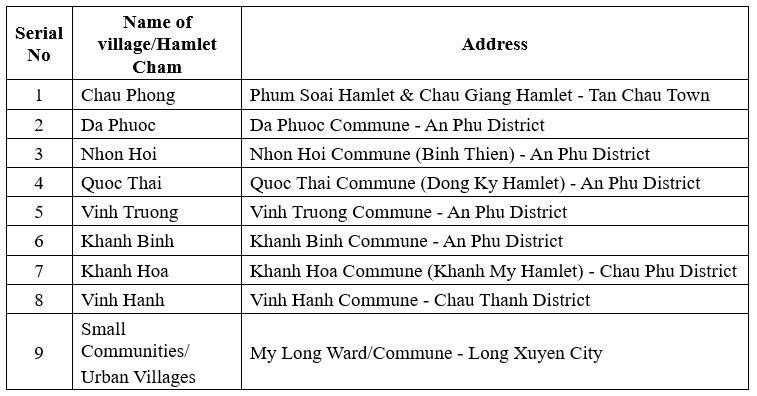
An Giang province currently has 9 Cham villages, distributed across Tan Chau town and three districts: An Phu, Chau Phu, and Chau Thanh. The Cham population resides scattered along the banks of rivers and canals, which is well-suited to the waterway environment and supports daily life, traditional occupations, and riverine transportation (Minh Duc, 2025).
Table 1. Cham villages, hamlets in An Giang province
4.2. Creative tourism activities in Cham villages
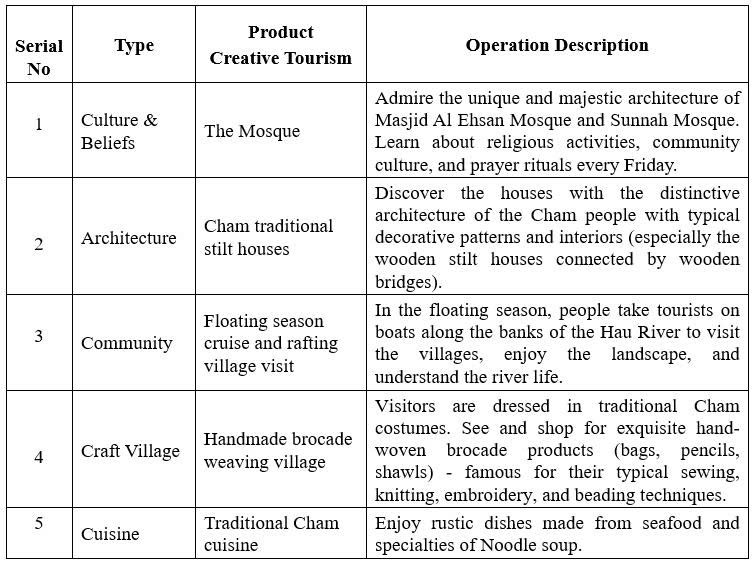
Of the nine Cham villages, there are two with strong tourism activities, namely Cham Chau Phong and Da Phuoc villages.
Table 2. Creative tourism activities in Cham Chau Phong village
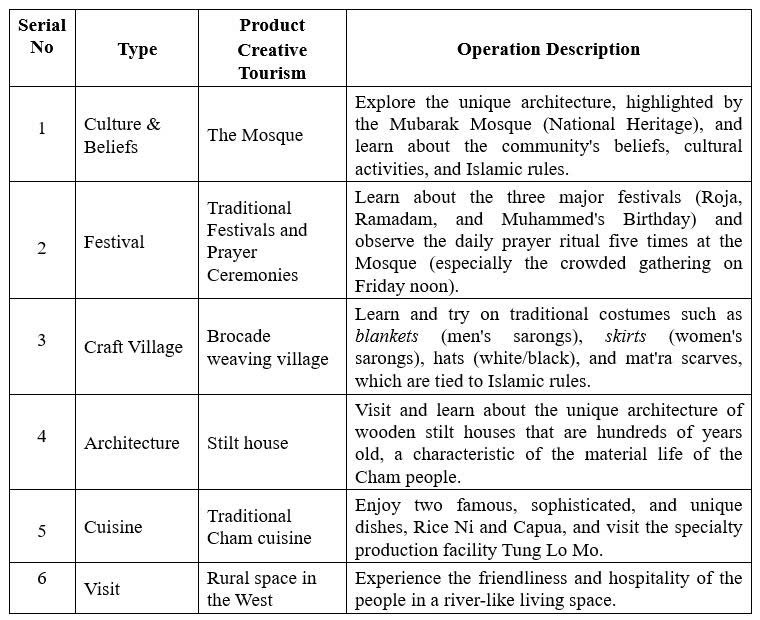
Table 3. Creative tourism activities in Cham Da Phuoc village
4.3. Favorable development of creative tourism in Cham villages
The two villages of Cham Chau Phong (Tan Chau town) and Da Phuoc (An Phu district) on both banks of the Hau River are the favorite destinations of many tourists on the journey to An Giang (Trieu Phu, 2025). Cham Da Phuoc village has an average of about 3,000 tourists per month, with many foreign visitors (Phuong Nghi, 2023).
Security and social order are well maintained, along with a quiet, undragged space. This affords visitors peace of mind, encouraging in-depth cultural visits and research without any pressure (Yen Luong, 2024).
The majestic Cham mosques, reflecting Indian and Persian architectural influences, remain open continuously and allow visitors to enter. This accessibility provides an ideal opportunity for tourists to directly observe and appreciate Cham Islamic architecture and religious practices. Such experiences not only enhance cultural understanding but also foster meaningful engagement between visitors and the local Cham community, contributing to the development of cultural and creative tourism in the region.
Craft brocade weaving is promoted, with looms operating continuously. The ingenuity of Cham women in weaving and beading techniques creates sophisticated products, attracting tourists to experience the process of crafting and shopping (Linh Trang, 2023).
The traditional wooden stilt house architecture is preserved intact, with unique linked staircases. This structure creates a distinct cultural experience space, attractive to international tourists who are keen to explore indigenous architecture.
The Cham community possesses a rich culinary culture with distinctive dishes such as Ni rice, Ca pua, Tung lo mo, and Curry. This culinary heritage provides a solid foundation for developing services that teach traditional cooking techniques and offer authentic Cham dining experiences. Such initiatives align well with the growing demand for creative culinary tourism, allowing visitors to engage actively with local food culture while preserving and promoting indigenous gastronomic traditions.
Cham villages regularly host religious festivals (Roya, Ramadan) and Culture, Sports, and Tourism Festivals. This creates opportunities for visitors to participate and interact through activities such as costume shows, wedding reconstructions, and folk games.
Local residents engaged in tourism are exceptionally friendly and enthusiastic, often serving visitors while dressed in traditional Cham attire. This not only enhances the authenticity and cultural richness of the visitor experience but also allows tourists to immerse themselves more deeply in the daily life and traditions of the Cham community. By witnessing and interacting with locals in their cultural context, visitors gain a more meaningful and memorable experience, which contributes to the development of creative and culturally grounded tourism in the region.
4.4. Limitations in the development of creative tourism in Cham villages
An Giang province has a total of nine Cham villages, but only two have really developed creative tourism: Da Phuoc and Chau Phong. Not all types of tourism fully exploit the remaining Cham villages.
Creative tourism in Cham village is facing a great challenge in terms of the monotony of experiential products, which reduces its ability to attract visitors to return. Moreover, the lack of homestay accommodation services and restaurants officially exploiting Cham cuisine makes it impossible for tourists to stay to learn more about the community's culture, often only visiting for the day and then leaving for Chau Doc (Hanh Chau, 2024).
Infrastructure and communication are significant barriers. Craft villages lack official information channels (website/homepage) for tourists to access on their own, making it difficult to do tourism planning. Further, the attractions are scattered; the lack of clear signage, along with the inconvenience of transportation (dependence on the ferry at Chau Phong), reduces the creative tourism meaning for visitors.
Human resources for tourism have not been trained in depth and have limited foreign language skills. This hinders the transmission of cultural values and craft village stories fully and deeply to international tourists. In addition, the lack of linkage between households in the community leads to fragmented tourism activities, which have not created an overall value chain and experience (Phong Diep, Thanh Binh, 2024).
5. Innovative tourism development solutions in Cham villages
There is a need to further deepen creative activities at traditional craft villages by transforming handwoven textile production into co-creative experiences. This would allow visitors to actively participate in weaving or beadwork processes, rather than merely observing. Such hands-on engagement not only enhances tourists’ understanding of Cham craftsmanship but also fosters personal creativity and meaningful interaction with local artisans, thereby strengthening the appeal of creative tourism at these craft villages.
The Cham community’s rich culinary culture, featuring distinctive dishes such as Ni rice, Ca pua, Tung lo mo, and Curry, provides a strong foundation for developing services that teach traditional cooking techniques and offer authentic Cham cuisine. These initiatives enable visitors to actively engage in culinary experiences, fostering both cultural appreciation and the promotion of Cham gastronomy as an integral part of creative tourism.
It is necessary to plan how to exploit creative tourism in the remaining 7 Cham villages, not only focusing on Chau Phong and Da Phuoc, in order to diversify products and avoid fragmented tourism. This helps to improve competitiveness and contribute to the sustainable development of tourism destinations.
In terms of infrastructure, it is necessary to overcome limitations such as traffic inconvenience (dependence on ferries in Chau Phong) and install clear signage at scattered attractions. At the same time, it is necessary to build an official information channel (website/homepage) for craft villages, solving the lack of information channels for tourists to access on their own.
Encourage and support the community to exploit the architecture of traditional wooden stilt houses to develop homestay services, create a separate cultural experience space, and help tourists stay to learn more about the community's culture.
Training programs should be organized for local residents in the Cham villages. At the same time, collaborative models among households can be established to create a comprehensive value chain and holistic visitor experiences. Such initiatives not only enhance the skills and capabilities of local communities but also promote integrated and sustainable creative tourism by linking production, cultural engagement, and experiential activities.
References
Linh Trang. (2023). Cham village in An Giang does tourism, attracting tourists to experience typical culture. Available at https://vietnamnet.vn/lang-cham-o-an-giang-lam-du-lich-hut-khach-toi-trai-nghiem-van-hoa-dac-trung-2346710.html
Hanh Chau (2024). An Giang: Developing specific products for tourism of the Cham people. Available at https://dantoc.vietnamtourism.gov.vn/an-giang-phat-trien-san-pham-dac-thu-phuc-vu-du-lich-cua-dong-bao-cham/
OECD. (2014). The Missing Entrepreneurs 2014: Fostering Entrepreneurship Education and Training. OECD Publishing.
Pham Trung Luong. (2025). Creative Tourism Development in Vietnam: Awareness, Reality and Issues to Concern. In the Proceedings of the International Conference on Creative Tourism - Sustainable Destination Development. Vietnam Institute of Culture, Arts, Sports and Tourism.
Phong Diep, Thanh Binh. (2024). Preserving and promoting brocade weaving of the Cham people in An Giang. Available at https://nhandan.vn/bao-ton-va-phat-huy-nghe-det-tho-cam-cua-dong-bao-cham-tai-an-giang-post831836.html
Phuong Nghi (2023). Tourism development in Cham An Giang village. Available at https://dantocphattrien.vietnamnet.vn/phat-trien-du-lich-lang-cham-an-giang1688719131714.htm
Richards, G., & Raymond, C. (2000). Creative Tourism. ATLAS News, 23, 16-20.
Trieu Phu. (2025). Many new features in Cham village tourism in An Giang. Available at https://baocantho.com.vn/nhieu-net-moi-trong-du-lich-lang-cham-o-an-giang-a182121.html
UNESCO. (2006). Towards Sustainable Strategies for Creative Tourism: Discussion report of the planning meeting for the 2008 International Conference on Creative Tourism. Available at https://unesdoc.unesco.org/ark:/48223/pf0000159811
Yen Luong. (2024). Highlights of Cham Da Phuoc village tourism. Available at https://baoangiang.com.vn/diem-nhan-du-lich-lang-cham-da-phuoc-a395423.html
Received date: October 15, 2025
Reviewed date: October 26, 2025
Accepted date: November 5, 2025
Thúc đẩy phát triển du lịch sáng tạo tại các làng của người Chăm ở tỉnh An Giang: Thực trạng và giải pháp
Nguyễn Tương Lai
Trường Đại học Tây Đô
Tóm tắt:
Nghiên cứu này phân tích quá trình phát triển du lịch sáng tạo tại các làng của người Chăm ở tỉnh An Giang. Trước hết, nghiên cứu hệ thống hóa mạng lưới chín làng Chăm và mô tả chuyên sâu các hoạt động du lịch sáng tạo tại hai làng tiêu biểu là làng Châu Phong và làng Đa Phước. Mặc dù sở hữu nền văn hóa đặc sắc và truyền thống hiếu khách, du lịch sáng tạo ở các làng Chăm vẫn còn hạn chế bởi sự đơn điệu trong trải nghiệm và thiếu hụt dịch vụ lưu trú homestay. Kết quả nghiên cứu cho thấy các làng Chăm có tiềm năng lớn trong việc mở rộng và đa dạng hóa các hoạt động đồng sáng tạo, đặc biệt là đối với nghề dệt truyền thống và ẩm thực. Trên cơ sở đó, nghiên cứu đề xuất một số giải pháp nhằm nâng cao mức độ tham gia của du khách, tăng cường sự gắn kết cộng đồng và thúc đẩy phát triển bền vững mô hình du lịch sáng tạo tại các làng Chăm.
Từ khoá: du lịch sáng tạo, các làng Chăm, nghề dệt truyền thống của người Chăm.
[Tạp chí Công Thương - Các kết quả nghiên cứu khoa học và ứng dụng công nghệ, số 33 năm 2025]