
Abstract:
This study investigates the determinants of business performance among construction enterprises in Can Tho City, Vietnam. Using a sample of 200 firms, multivariate ordinary least squares (OLS) regression models were applied to assess the effects of managerial demographics, firm characteristics, and digital transformation variables on three financial performance metrics: Return on Assets (ROA), Return on Equity (ROE), and Return on Sales (ROS). Results indicate that firm size, revenue, and managerial age positively influence performance, while fixed assets and digital maturity show negative or insignificant effects in certain models. Interaction terms between digital maturity and age reveal moderating effects on performance. The findings highlight the importance of aligning digital investments with organizational readiness and recommend policy interventions tailored to firm capabilities.
Keywords: construction enterprises, business performance, digital transformation, firm characteristics, SMEs, Can Tho City, ROA, ROE, ROS.
1. Introduction
The construction sector plays a pivotal role in Vietnam’s economic development, contributing approximately 6.2% to national GDP in 2023 and responding to growing urbanization and infrastructure investment (General Statistics Office of Vietnam, 2023). Despite this growth, many construction firms - especially SMEs - face persistent challenges such as inefficient project management, limited access to finance, and inconsistent digital adoption (Nguyen et al., 2023).
Globally, the construction industry is being transformed by Industry 4.0, with digital technologies like Building Information Modeling (BIM), cloud-based project tools, and analytics becoming mainstream (Lu et al., 2020; World Economic Forum, 2018). These innovations are linked to improved decision-making, cost efficiency, and resource allocation (Gao et al., 2023; Yu et al., 2023). However, their effectiveness is shaped by internal firm characteristics, including leadership capacity, strategic alignment, and organizational structure (Ali & Shabir, 2017; Wang et al., 2020).
While previous studies have explored digital transformation’s impact on firm performance, most focus on large firms in advanced economies. Little is known about how digitalization interacts with internal firm capabilities to influence SME performance in the construction sector, particularly in emerging regions like Can Tho. This study addresses that gap by examining the determinants of business performance among local construction enterprises, emphasizing firm characteristics and digital maturity. It aims to generate empirical insights to inform both theory and regional policy, contributing to Vietnam’s broader goals of digital and industrial modernization.
2. Literature review
The performance of construction enterprises has attracted increasing scholarly attention due to the growing interaction between firm-specific characteristics and digital transformation. In emerging economies such as Vietnam, where construction firms face market volatility, regulatory pressures, and technological change, understanding these performance drivers is particularly important.
Firm characteristics play a central role in shaping business outcomes. Prior studies emphasize leadership quality, governance, and strategic resource allocation as key determinants of competitiveness (Ali & Shabir, 2017). Embedding sustainability and effective risk management into firm strategy further enhances performance and resilience in dynamic environments (Chang et al., 2017; Zhao et al., 2014). In project-based industries like construction, intangible assets - such as managerial experience and organizational culture - are especially critical for adapting to uncertainty (Wang et al., 2020).
Digital transformation has emerged as an important performance-enhancing mechanism under Industry 4.0. Empirical evidence suggests that digital technologies improve decision-making, cost control, and resource efficiency (Gao et al., 2023; Yu et al., 2023). Digital preparedness also strengthened SME resilience during recent crises, highlighting its strategic relevance (Bai et al., 2021).
However, existing research remains largely concentrated on large firms or non-construction sectors, with limited empirical evidence from regional construction SMEs in Vietnam. This study addresses this gap by examining how firm characteristics and digital maturity jointly influence performance in construction enterprises in Can Tho City. By providing localized empirical evidence, the study contributes to a more nuanced understanding of digital transformation and firm performance in emerging market contexts.
3. Research model and hypotheses
3.1 Variables
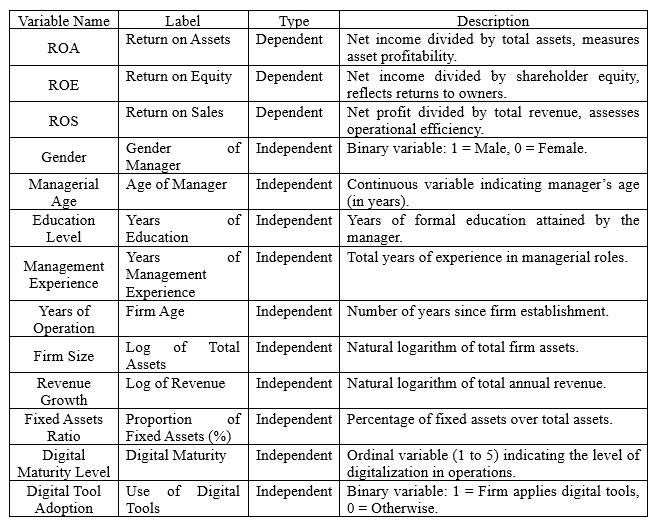
Table 1. Description of Variables Used in the Model
3.2 Research model and hypotheses
This study develops a conceptual model to examine how internal firm characteristics and digital transformation contribute to business performance among construction enterprises in Can Tho City. Drawing from the resource-based view (RBV) and digital capability theory, the model posits that both tangible resources (e.g., firm size, fixed assets) and intangible capabilities (e.g., managerial experience, digital maturity) serve as key determinants of firm performance (Barney, 1991; Zomer et al., 2020).
Figure 1 illustrates the proposed research model, which includes three dimensions of firm performance - ROA, ROE, and ROS - as dependent variables. The independent variables are grouped into three clusters: (1) entrepreneur demographics, (2) firm characteristics, and (3) digital transformation metrics.
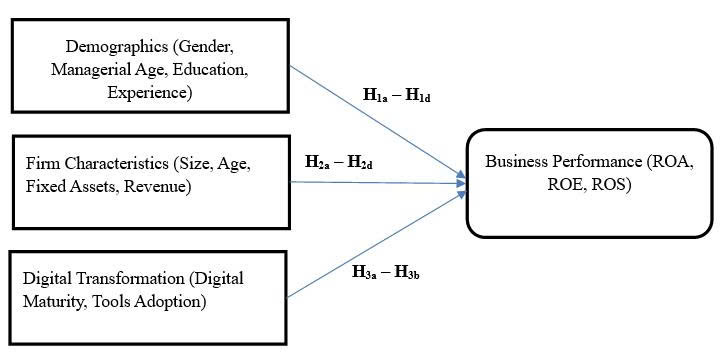
Figure 1. Conceptual research model
Hypotheses development:
A. Demographic factors and firm performance
Demographic traits of business owners are hypothesized to affect strategic choices, risk aversion, and openness to innovation - all of which influence firm performance (Ali & Shabir, 2017).
H1a: Owner’s gender significantly influences firm performance.
H1b: Owner’s age is positively associated with firm performance.
H1c: Owner’s education level is positively associated with firm performance.
H1d: Owner’s management experience positively affects firm performance.
B. Firm characteristics and performance
Firm-level attributes such as operational age, and asset scale are widely considered as structural determinants of firm success (Chang et al., 2017; Wang et al., 2020).
H2a: Firm size (log of total assets) is positively related to firm performance.
H2b: Years of operation are positively associated with firm performance.
H2c: A higher ratio of fixed assets enhances performance outcomes.
H2d: Revenue growth rate is positively correlated with firm performance.
C. Digital transformation and performance
Digital transformation represents a critical strategic capability for firms, particularly in rapidly changing environments. Technological integration allows for improved efficiency, project coordination, and innovation (Gao et al., 2023; Yu et al., 2023).
H3a: Higher levels of digital maturity are positively associated with firm performance.
H3b: The application of digital tools in core operations positively affects firm performance.
3.3 Data collection and methodology
This study adopts a quantitative research design. Primary data were collected between June and November 2025 through a structured questionnaire survey targeting small and medium-sized construction enterprises operating in Can Tho City.
Stratified random sampling ensured representation across districts, while purposive sampling was used to select appropriate respondents - firm owners or senior managers with decision-making authority. The questionnaire captured information on firm performance, managerial demographics, firm characteristics, and digital transformation practices. A pilot test with 15 firms confirmed clarity and reliability.
Out of 230 distributed questionnaires, 212 were returned and 200 deemed valid, yielding an effective response rate of 86.96%. This sample size is sufficient for multivariate regression analysis.
3.4 Analytical methods
To assess the impact of the independent variables on firm performance, multiple linear regression models were estimated separately for each dependent variable (ROA, ROE, and ROS). The models take the following general form:
Performancei = β0 + β1Demographicsi + β2FirmFactorsi + εi
Where:
Performancei is one of the three performance indicators for firm i,
Demographics: Manager’s age, education (measured in years), experience (measured in years), and gender ((binary: male = 1, female = 0).
FirmFactors: Firm size (log), revenue (log), years of operation, fixed assets, digital maturity, tool adoption.
βk are the estimated coefficients
εi is the error term.
Before regression estimation, diagnostic tests were performed to check for multicollinearity (VIF), normality, and heteroscedasticity.
4. Results and discussion
4.1. Diagnostic tests and robust estimation
Several diagnostic tests were conducted to ensure the validity of the regression models. Multicollinearity was not a concern, as all Variance Inflation Factor (VIF) values were below 1.5 (mean VIF = 1.30). Breusch–Pagan tests indicated heteroskedasticity in the ROA and ROE models (p < 0.001), while the ROS model satisfied the homoskedasticity assumption (p = 0.609). Accordingly, robust standard errors were applied across all models to ensure consistent inference. Residual normality tests (Skewness–Kurtosis) suggested marginal deviations from normality (p = 0.091), which are acceptable given the large sample size.
Model fit statistics indicate moderate explanatory power. Adjusted R² values range from 25.7% (ROA) to 36.8% (ROE). The ROA model exhibits the lowest RMSE (4.00), indicating superior predictive accuracy relative to the ROE (7.09) and ROS (8.18) models. Consistent with this result, the ROA model also records the lowest AIC and BIC values, suggesting the best balance between model fit and parsimony. Although the ROS model shows a relatively higher R², its higher AIC and BIC values may indicate potential overfitting.
4.2. Regression results
Table 2 summarizes the robust regression results.
Table 2. OLS Regression Results for ROA, ROE, and ROS
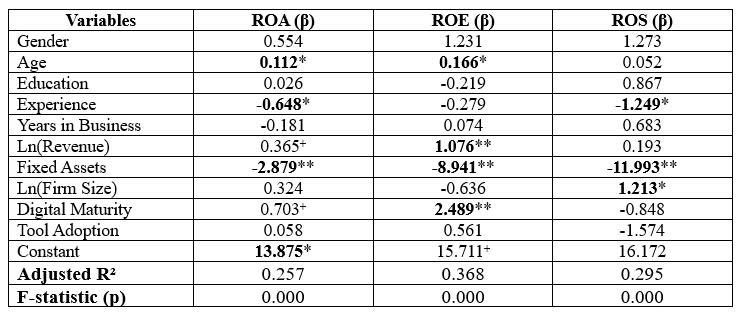
Note: (*p < 0.05; **p < 0.01; +p < 0.1)
The results revealed that age and firm revenue were positively associated with ROA and ROE, suggesting that maturity and financial strength enhance financial performance. This aligns with the Resource-Based View (RBV), which emphasizes the role of valuable, rare, and inimitable resources (Barney, 1991).
Conversely, managerial experience and fixed asset intensity had negative impacts across most models. This suggests that seasoned managers may be less adaptable to digital transformation or new technologies, consistent with findings by Bai et al. (2021). Similarly, excessive capital tied up in assets may reduce liquidity and agility, a point raised by Zhao et al. (2014).
Firm size significantly increased ROS but had no impact on ROE or ROA. This confirms the observations of Wang et al. (2020) that larger firms may benefit from operational leverage and better client portfolios, improving sales efficiency but not necessarily profitability.
Finally, education and tool adoption were not significant predictors in any model. This finding supports Vu et al. (2020), who argued that formal qualifications may not fully capture managerial capabilities in Vietnam’s construction sector.
5. Conclusion and policy implications
This study provides empirical evidence on the determinants of business performance among construction enterprises in Can Tho City, focusing on firm characteristics, digital maturity, and managerial demographics. Using multivariate OLS regression on data from 200 firms, the analysis evaluates three performance indicators: ROA, ROE, and ROS.
The results confirm that firm size and revenue growth are consistently and positively associated with performance, supporting the Resource-Based View that firm-specific resources underpin competitive advantage (Barney, 1991; Wang et al., 2020). In contrast, fixed asset intensity exhibits a negative relationship with all three performance measures, suggesting inefficiencies in capital utilization and reduced operational flexibility, particularly among SMEs.
Notably, digital maturity shows a negative association with short-term performance indicators (ROA and ROS), indicating that digital transformation does not automatically yield immediate efficiency gains unless it is well integrated into business processes and workforce practices. Similarly, managerial experience is negatively related to ROS, implying that accumulated experience alone may be insufficient in rapidly evolving digital environments without continuous upskilling.
Although interaction effects between managerial characteristics and digital maturity were initially considered, severe multicollinearity led to their exclusion, pointing to the need for alternative methodological approaches in future research.
From a policy perspective, digital investment strategies should prioritize organizational readiness and workforce capability rather than technology adoption alone. Improving asset allocation efficiency, supporting growth-oriented SMEs, reskilling senior managers in digital leadership, and tailoring digital transformation policies to local conditions are essential to enhancing the competitiveness and sustainability of construction firms in the Mekong Delta.
References:
Ali, J. and Shabir, S. (2017). Does gender make a difference in business performance? Gender in Management an International Journal, 32(3), 218-233. https://doi.org/10.1108/gm-09-2016-0159
Bai, C., Quayson, M., & Sarkis, J. (2021). Covid-19 pandemic digitization lessons for sustainable development of micro-and small- enterprises. Sustainable Production and Consumption, 27, 1989-2001. https://doi.org/10.1016/j.spc.2021.04.035
Barney, J. B. (1991). Firm resources and sustained competitive advantage. Journal of Management, 17(1), 99-120. https://doi.org/10.1177/014920639101700108Chang, R., Zuo, J., Soebarto, V., Zhao, Z., Zillante, G., & Gan, X. (2017). Discovering the transition pathways toward sustainability for construction enterprises: importance-performance analysis. Journal of Construction Engineering and Management, 143(6). https://doi.org/10.1061/(asce)co.1943-7862.0001295
Chenhall, R. H., & Langfield-Smith, K. (2007). Multiple perspectives of performance measures. European Management Journal, 25(4), 266-282.
Gao, D., Yan, Z., Zhou, X., & Mo, X. (2023). Smarter and prosperous: digital transformation and enterprise performance. Systems, 11(7), 329. https://doi.org/10.3390/systems11070329
Gherghina, Ș. C., Botezatu, M. A., Hosszu, A., & Simionescu, L. N. (2020). Small and medium-sized enterprises (SMEs): The engine of economic development. Sustainability, 12(10), 426. https://doi.org/10.3390/su12104266
Ittner, C. D., & Larcker, D. F. (2003). Coming up short on nonfinancial performance measurement. Harvard Business Review, 81(11), 88-95.
Liu, F. and Zhang, L. (2024). The role of digital resilient agility: how digital capability incompatibility affects knowledge cooperation performance in project network organizations. Journal of Knowledge Management, 29(1), 25-48. https://doi.org/10.1108/jkm-11-2023-1067
Lu, Y., Wu, Z., Chang, R., & Li, Y. (2020). Building Information Modeling (BIM) for green buildings: A critical review and future directions. Automation in Construction, 109, 102930. https://doi.org/10.1016/j.autcon.2019.102930.
Nguyen, X., Nguyen, K., Nguyen, T., Nguyen, T., & Ta, V. (2023). The impact of green organizational capabilities on competitive advantage of construction enterprises in Vietnam: the mediating role of green innovation. Sustainability, 15(16), 12371. https://doi.org/10.3390/su151612371
Vu, T., Hoang, L., Thi, H., Phan, T., & Nguyen, T. (2020). Influence of components of internal control on the effectiveness of internal control: evidence from transport construction enterprises in Vietnam. Journal of Asian Finance Economics and Business, 7(11), 1087-1095. https://doi.org/10.13106/jafeb.2020.vol7.no11.1087
Wang, W., Lin, W., Dai, X., Yan, Y., & Xuan, A. (2020). Evaluating the sustainable growth of small- and medium-sized construction enterprises using the multicriteria decision-making method. Discrete Dynamics in Nature and Society, 2020, 1-13. https://doi.org/10.1155/2020/3151949
World Economic Forum. (2018). Shaping the Future of Construction: Future Scenarios and Implications. World Economic Forum. https://www.weforum.org/reports/shaping-the-future-of-construction.
Yu, W., Huang, H., & Zhu, K. (2023). Enhancing construction enterprise financial performance through digital inclusive finance: an insight into supply chain finance. Sustainability, 15(13), 10360. https://doi.org/10.3390/su151310360
Zhao, X., Hwang, B., & Low, S. (2014). Enterprise risk management implementation in construction firms. Management Decision, 52(5), 814-833. https://doi.org/10.1108/md-02-2014-0082
Zomer, T., Neely, A., & Martinez, V. (2020). Digital transforming capability and performance: a micro foundational perspective. International Journal of Operations & Production Management, 40(7/8), 1095-1128. https://doi.org/10.1108/ijopm-06-2019-0444
Các yếu tố quyết định hiệu quả hoạt động của doanh nghiệp xây dựng tại thành phố Cần Thơ: Vai trò của đặc điểm doanh nghiệp và chuyển đổi số
Đinh Vũ Long
Trường Đại học Tây ĐôTóm tắt:
Nghiên cứu này phân tích các yếu tố quyết định hiệu quả hoạt động của các doanh nghiệp xây dựng tại thành phố Cần Thơ, Việt Nam. Dựa trên mẫu dữ liệu gồm 200 doanh nghiệp, các mô hình hồi quy bình phương tối thiểu thông thường (OLS) được sử dụng nhằm đánh giá tác động của đặc điểm nhân khẩu học của nhà quản lý, đặc điểm doanh nghiệp và các biến liên quan đến chuyển đổi số đến ba chỉ tiêu hiệu quả tài chính, bao gồm: tỷ suất sinh lời trên tài sản (ROA), tỷ suất sinh lời trên vốn chủ sở hữu (ROE) và tỷ suất sinh lời trên doanh thu (ROS). Kết quả cho thấy quy mô doanh nghiệp, doanh thu và độ tuổi của nhà quản lý có tác động tích cực đến hiệu quả hoạt động; trong khi tỷ trọng tài sản cố định và mức độ trưởng thành số thể hiện tác động tiêu cực hoặc không có ý nghĩa thống kê trong một số mô hình. Các biến tương tác giữa mức độ trưởng thành số và độ tuổi cho thấy tồn tại vai trò điều tiết đối với hiệu quả hoạt động. Phát hiện từ nghiên cứu nhấn mạnh tầm quan trọng của việc gắn kết đầu tư chuyển đổi số với mức độ sẵn sàng của tổ chức, đồng thời đề xuất các can thiệp chính sách phù hợp với năng lực của doanh nghiệp.
Từ khóa: chuyển đổi số, doanh nghiệp nhỏ và vừa, doanh nghiệp xây dựng, đặc điểm doanh nghiệp, hiệu quả hoạt động, ROA, ROE, ROS, TP.Cần Thơ.
(Tạp chí Công Thương - Các kết quả nghiên cứu khoa học và ứng dụng công nghệ, số 4 năm 2026)