Determinants of consumer ad avoidance behavior on social media platforms
The study entitled “Determinants of Consumer Ad Avoidance Behavior on Social Media Platforms” was conducted by Le Thi Phuoc, Nguyen Thi Xuan An, Nguyen Phuong Quynh, Vo Phuong Anh, Vo Thi My Le, Nguyen Tran Nhat Mai, Chau Kim Ngan, Thai Duy Nam, Nguyen Phuong Ngoc Quyen, and Nguyen Le Ngoc Han, affiliated with Ho Chi Minh City University of Technology and Engineering.

Abstract:
This study examines the determinants of users’ advertisement avoidance behavior on social networking platforms. Data were collected from 201 respondents, predominantly young individuals living and working in Ho Chi Minh City. A mixed-methods research design was employed, comprising an initial qualitative phase to refine measurement constructs, followed by quantitative analysis using SPSS. The results show that perceived informativeness, relevance, entertainment, and credibility are negatively associated with ad avoidance, whereas perceived interruption and annoyance are positively associated with users’ avoidance behavior. Notably, interruption and annoyance emerge as the most influential predictors of advertisement avoidance, underscoring their central role in shaping users’ responses to social media advertising.
Keywords: Ad avoidance, social media, consumers, behavior.
1. Introduction
In the current era of digital transformation, social media platforms have evolved beyond simple spaces for communication and sharing into potent instruments for enterprises to engage with their consumer base. Concurrently, with the proliferation of advertising across major platforms, including Facebook, Instagram, TikTok, and YouTube, an observable phenomenon has emerged: an increasing proportion of users are developing habitual behaviors characterized by the avoidance or deliberate inattention toward advertisements embedded within their content feeds. This trend not only reflects a significant shift in consumer behavior but also presents formidable challenges to the marketing industry, particularly concerning the sustainability and efficacy of digital advertising campaigns.

As of January 2024, Vietnam reported 72.70 million social media users, constituting approximately 73.3% of the total population. Despite this vast reach, the escalating volume and frequency of advertising activities are demonstrably detrimental to the user experience. Faced with these realities, ad avoidance behavior is becoming an increasingly default response utilized by the majority of users to counteract the currently unregulated advertising saturation. This specific behavior has created, and continues to generate, significant obstacles to the advertising efforts of contemporary businesses (Huynh Nhut Phuong et al. (2022)).
The decision to investigate consumer ad avoidance behavior on social media platforms is necessitated not only by the critical and timely nature of the issue but also by the extensive potential for practical application within the fields of marketing and communication. This research endeavor is anticipated to contribute towards developing pragmatic solutions for enterprises, enabling them to enhance advertising effectiveness and concurrently ameliorate the user experience on social media.
2. Theoretical foundation and research methodology
2.1. Theoretical foundation
Ad avoidance behavior (AAB) on social media is influenced by many factors related to users' perceptions and experiences when exposed to advertising content.
Informativeness (IN) refers to the extent to which advertisements provide useful information to users, such as product information, prices, and promotions. Highly informative advertisements can increase perceived value, thereby reducing the likelihood of avoidance by users (Ho Truc Vi et al., 2018 and Huynh Nhat Phuong et al., 2022).
Relevance (RL) reflects the degree of alignment between the advertisement and the user's needs, preferences, or personal circumstances. Relevant content increases attention levels and reduces avoidance behavior (Ho Truc Vi et al., 2018; Huynh Nhat Phuong et al., 2022).
Advertising disruption (AD) is the user's perception when ads interrupt primary activities such as browsing the web, watching videos, or interacting with friends. Disruptive ads are often negatively perceived and more likely to be avoided by viewers (Huynh Nhat Phuong et al., 2022).
Annoyance (AN) is the level of discomfort or irritation caused by repetitive, inappropriate, or forced advertisements. The discomfort caused by social media advertisements has a significant and strong impact on ad avoidance behavior (Đinh Tiên Minh et al., 2021).
Entertainment value (EV) reflects the level of fun, creativity, or visual and emotional appeal of an advertisement. When advertisements have high entertainment value, users tend to respond more positively and are less likely to avoid them (Ho Truc Vi et al., 2018; Luu Thi Minh Ngoc & Hoang Trong Truong, 2020).
Credibility (CR) refers to the degree to which users trust the information in the advertisement and the brand. If an advertisement is perceived as credible, users are less likely to avoid it. (Luu Thi Minh Ngoc và Hoang Trong Truong, 2020; Ho Truc Vi and Phan Trong Nhan, 2019).
2.2. Research Methodology
In this study, the sample size was determined using the Slovin formula and stratified random sampling method, yielding 201 valid samples. The survey was conducted from February to March 2025 via an electronic questionnaire on Google Forms, distributed through social media channels to expand its reach. Data were analyzed using multiple linear regression after checking the reliability of the scale using Cronbach's Alpha and the relationship between variables using Pearson's correlation coefficient. The regression model was evaluated through t, F, R², VIF, and Durbin-Watson tests to ensure stability, reliability, and the ability to reflect the research practice. (Thi Minh Ngoc & Hoang Trong Truong, 2020; Ho Truc Vi & Phan Trong Nhan, 2019).
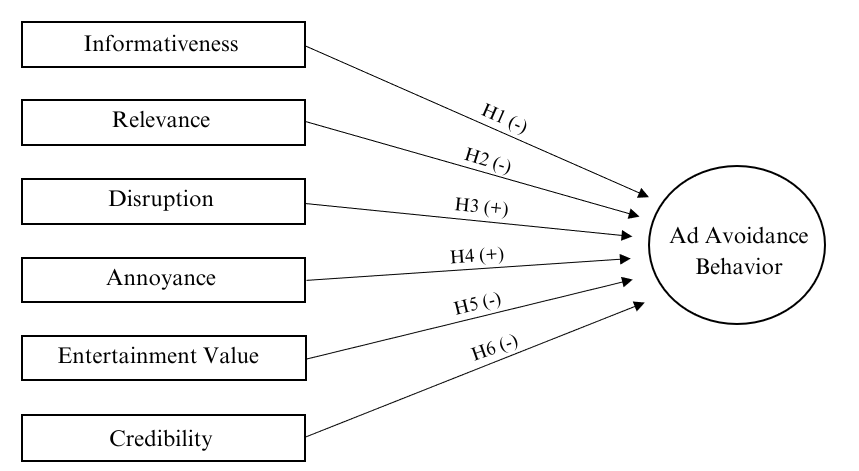
Figure 1. Research framework
3. Research results
3.1. Descriptive statistics
The survey studied 201 consumers in Vietnam, mainly young people (aged 18-24, accounting for 61.7%), unmarried (75.9%), and with an income of less than VND 10 million per month (27.9% less than VND 5 million). In terms of gender, women accounted for 50.7%. Facebook was the most popular platform (29.5%), followed by TikTok (26.7%), Instagram (22.2%), and YouTube (21.6%). The main purposes of using social media are entertainment (27.9%), news updates (25%), and communication (23.9%). In addition, 23.2% of users also use social media to learn and search for professional information.
3.2. Summary of factors
To test the reliability of the measurement scales, the research team used Cronbach's Alpha coefficient. The analysis results show that most variables have a total variable correlation value greater than 0.3, ensuring reliability requirements. The variables were then subjected to further analysis. All 24 observed variables met the conditions and standards to proceed to the next steps of analysis.
3.3. Exploratory Factor Analysis (EFA)
For the independent variable: The KMO index reached 0.934, indicating that the data was suitable for analysis. Bartlett's Test yielded a Chi-square value of 2,630.429 and Sig. = 0.000, confirming the existence of a relationship between the variables. The extraction results show 6 factors with eigenvalues > 1, explaining 57.706% of the total variance. All loadings are greater than 0.5, reflecting good convergence and discrimination of the scales.
For the dependent variable: The KMO index = 0.756 and Bartlett's Test has Sig. = 0.000, indicating that the data meets the conditions for analysis. A single factor was extracted with an eigenvalue = 2.508, explaining 62.708% of the variance. All AAB variables had factor loadings above 0.7, demonstrating that they consistently reflect the concept of “advertising avoidance.”
Table 1. Regression Model Results
|
Model |
Unstandardizied Coefficients |
Standardizied Coefficients |
t |
Sig. |
Collinearity Statistics |
|||
|
B |
Std. Error |
Beta |
Tolerance |
VIF |
||||
|
1 |
(Constant) |
0.330 |
0.214 |
|
1.545 |
0.124 |
|
|
|
IN |
0.067 |
0.063 |
0.065 |
1.068 |
0.287 |
0.556 |
1.799 |
|
|
RL |
0.087 |
0.074 |
0.080 |
1.172 |
0.243 |
0.441 |
2.267 |
|
|
AD |
0.177 |
0.081 |
0.169 |
2.188 |
0.030 |
0.349 |
2.866 |
|
|
AN |
0.054 |
0.067 |
0.058 |
0.808 |
0.420 |
0.402 |
2.488 |
|
|
EV |
0.399 |
0.076 |
0.414 |
5.231 |
0.000 |
0.331 |
3.019 |
|
|
CR |
0.131 |
0.080 |
0.129 |
1.633 |
0.104 |
0.331 |
3.017 |
|
|
a. Dependent variable: AAB |
||||||||
The impact of independent variables: Among the six factors, only EV and AD are statistically significant (Sig. < 0.05).
Entertainment has a standardized Beta coefficient = 0.414, Sig. = 0.000, proving that this is the most important factor. Advertisements tend to be entertaining and humanistic, encouraging users to minimize ad avoidance. The independent variable AD has a Beta = 0.169, Sig. = 0.030, confirming that discomfort also promotes ad avoidance behavior.
3.4. Regression equation estimation (unstandardized coefficients):
AAB = 0.330 + 0.177 × AD + 0.399 × EV
The regression model analysis results show that all independent variables have a statistically significant effect on the dependent variable, Avoidance. Specifically, the factors include: Entertainment and Interruption. The remaining variables have Sig values >0.005, so they are not statistically significant and have been excluded from the model.
The adjusted R² value of the model is 0.585, while R² reaches 0.598, indicating that the model explains approximately 51.8% of the variance in the dependent variable. The Durbin–Watson test yielded a result of DW = 1.913, which falls within the acceptable range of 1.5 to 2.5, confirming that the model does not exhibit severe residual autocorrelation.
4. Conclusion
Based on a survey of 201 social media users to identify factors influencing ad avoidance behavior . Six initial factors were proposed: informational value, relevance, entertainment value, trustworthiness, interruption, and annoyance. The results of the measurement scale validation and factor analysis showed that the data was suitable and reliable.
Entertainment is the strongest determinant of advertising avoidance (β = 0.414, Sig = 0.000), indicating that ads that are engaging, creative, and emotionally appealing are less likely to be avoided. This finding is consistent with previous studies such as Ho Truc Vi & Phan Trong Nhan (2017) and Huynh Nhut Phuong et al. (2022). From a managerial perspective, firms should prioritize creative storytelling and emotional engagement instead of merely delivering product information. Intrusiveness also has a significant positive effect on advertising avoidance (β = 0.169, Sig = 0.030), meaning that ads appearing at inappropriate times or interrupting users’ activities increase avoidance. Therefore, marketers should optimize timing, frequency, and ad formats to minimize disruption to users’ social media experience.
Informativeness, relevance, credibility, and irritation do not significantly affect advertising avoidance, suggesting that social media users have become accustomed to frequent advertising and no longer respond strongly to rational content features. This result differs from Huynh Nhut Phuong et al. (2022), where irritation played a major role, indicating a shift in consumer behavior in today’s social media environment. Managerially, this implies that simply increasing information or credibility is insufficient to reduce ad avoidance. Instead, firms must focus on creating enjoyable and non-disruptive advertising experiences. Overall, the study confirms that advertising avoidance on social media is mainly driven by emotional value and intrusiveness, highlighting a new behavioral pattern compared with earlier research.
References:
Dinh Tien Minh, Nguyen Doan Nam Han, Tran Cat Tuong, Vo Huynh Song Thi, Nguyen Le Hoai Phuong & Bui Thi Ngoc Huyen.(2021). Analyzing the Impact of Online Video Advertising Characteristics on YouTube User Perceived Intrusiveness and Their Decision to Skip or Continue Watching. Asian Journal of Economics and Business Studies, 10, 96–119.
Ho Truc Vi & Phan Trong Nhan.(2019). Factors Affecting Facebook Ad Avoidance Among Young People in Ho Chi Minh City. Dalat University Journal of Science, 9(1S), 3-17.
Ho Truc Vi, Phan Thi Song Thuong & Phan Trong Nhan.(2018). Ad avoidance and brand awareness - a study of video advertising formats on social media platforms among young people in Ho Chi Minh City. Can Tho University Journal of Science, 54(4), 159.
Huynh Nhut Phuong, Nguyen Thuy An & Khuu Ngoc Huyen.(2023). Applying SOR model to study the factors affecting advertising avoidance behavior of Youtube users in Can Tho City. Ho Chi Minh City Open University Journal of Science - Economics and Business Administration, 18(5),73-84.
Luu Thi Minh Ngoc and Hoang Trong Truong.(2020). The nuisance of video ads on YouTube and their implications for Vietnamese businesses. University of Commerce Journal of Commercial Science 140, 44–53.
NGHIÊN CỨU CÁC YẾU TỐ QUYẾT ĐỊNH HÀNH VI NÉ TRÁNH QUẢNG CÁO CỦA NGƯỜI TIÊU DÙNG TRÊN CÁC NỀN TẢNG MẠNG XÃ HỘI
Lê Thị Phước¹
Nguyễn Thị Xuân An¹
Nguyễn Phương Quỳnh¹
Võ Phương Anh¹
Võ Thị Mỹ Lệ¹
Nguyễn Trần Nhật Mai¹
Châu Kim Ngân¹
Thái Duy Nam¹
Nguyễn Phương Ngọc Quyên¹
Nguyễn Lê Ngọc Hân¹
1 Trường Đại học Công nghệ Kỹ thuật TP.Hồ Chí MinhTóm tắt:
Nghiên cứu này nhằm phân tích các yếu tố tác động đến hành vi tránh né quảng cáo của người dùng trên mạng xã hội. Dữ liệu được thu thập từ 201 người dùng với đa số là giới trẻ sinh sống và làm việc tại TP.Hồ Chí Minh. Phương pháp nghiên cứu định lượng bằng SPSS được sử dụng để phân tích bên cạnh nghiên cứu định tính ở giai đoạn sơ bộ. Kết quả cho thấy có mối quan hệ ngược chiều của các yếu tố tính thông tin, tính liên quan, tính giải trí và độ tin cậy. Ngược lại, sự gián đoạn và sự phiền toái tác động thuận chiều đến hành vi né tránh quảng cáo. Ngoài ra, kết quả cho thấy sự gián đoạn và sự phiền toái là những thang đo tác động mạnh đến sự tránh né quảng cáo.
Từ khóa: Né tránh quảng cáo, mạng xã hội, người tiêu dùng, hành vi.
[Tạp chí Công Thương - Các kết quả nghiên cứu khoa học và ứng dụng công nghệ, Số 2/2026]