





Abstract:
This study highlights the importance of standardized competency development and assessment in training programs across educational levels. It examines the concepts, objectives, key questions, and application of Bloom’s taxonomy in developing standards for assessing learner and teacher competencies. Data were collected through a Likert-scale survey informed by Bloom’s taxonomy and analyzed using Microsoft Excel, SPSS, and AMOS. The study provides lecturers with a practical reference for designing competency-based training programs appropriate to Vietnam and adaptable to other educational contexts.
Keywords: learners, output standards, teachers, teaching quality, training program.
1. Introduction
Training programs at all levels of a training institution must be inherited, scientific, systematic and practical at the time of construction dramatic changes in technology 4.0. When building the standard output system for the learner, it is also the goals that have been achieved, the tasks have been completed, efforts of the learners are shown throughout the learning process, the achievements, successes of lecturers in education and training. Traditionally, traditional assessments are tests-based curriculum. This assessment method only assesses the level of comprehension of knowledge of learners. However, the new development trend of modern education, not only learners know, understand but also have the skills to apply knowledge learned in a dynamic, creative way as well as to solve problems, current problems and long term future. Therefore, the standard competencies and evaluation strategies need to be established, built on a recognized and applied scientific hierarchy so that it can reflect the quality of the training program itself, is to evaluate knowledge, skills and teaching experience.
2. Theoretical basis
2.1. The concept of student learning outcomes
Allen (2008), introduces the concept of student learning outcomes that describe how learners can demonstrate the ability to achieve the learning goals set by the curriculum. It shows the knowledge, skills and learning attitude, so that learners have the ability to self study or successfully apply into practice after completing a learning program.
2.2. The purpose of the training program is based on the learning outcomes of the learners
From a specific curriculum, when the learning outcomes are formulated and informed to learners, the first positive effects will be directed to themselves, namely:
1) Help learners and learn more effectively.
2) Help learners, understand the expectations that the learning program wants them to achieve, from which learners have the right learning attitude are highly disciplined and know how to develop and implement plans as well as personally manage your studies.
3) Helping teaching and learning to achieve good results will form the basis for the development of the overall curriculum, the curriculum of the subjects as well as the activities inside and outside the educational and training institution.
2.3. Questions to ask when developing a training program based on learners' output standards
1) What knowledge, skills, competencies and values the course is geared to equip the learners? How can learners achieve these competencies?
2) Does the program set out with this standard result prepare students well to continue their studies at higher levels, for future careers or for lifelong learning?
3) Is it geared to the development of learners' knowledge, skills, competencies, as well as living values through the curriculum?
2.4. Bloom's competency scale develops a standard curriculum for learners
Bloom (1956), power scale system has been used by many countries because of its science and reliability. From the cognitive criteria of this system, lecturers can build their own competency standards and evaluate the competency of learners through the subjects they are in charge. This scale has 6 levels sorted from low to high in the cognitive process of learners. See Table 1.
Table 1. Awareness ladder
|
Ladder |
Level |
Learing objectives |
|
1 |
Knowledge |
Know and understand the basis of reasoning, terminology, concepts, principles or theory. |
|
2 |
Comprehension |
Understand, explain, compare, contrast and clarify matters. |
|
3 |
Application |
Apply knowledge to new situations to solve problems. |
|
4 |
Analysis |
Identify the structural morphology of things, identify the parts, relationships and organizational principles. |
|
5 |
Synthesis |
Create an object, synthesize ideas to create a solution, propose an action plan and establish a new classification system. |
|
6 |
Valuation |
Evaluate the quality of things based on value, necessary and sufficient conditions and logic or utility. |
(Source: Bloom, 1956)
Based on the levels of cognitive processes that Bloom offers, the teaching process does not only stop providing knowledge, but learners need to enhance experience and practice, from which knowledge will be gained. learners apply creatively and in accordance with the actual conditions of a specific habitat. In the framework of this research, the author and et al added one more level of creativity to Bloom expanded to 7 levels.
2.5. How to use verbs to describe learners' competence
Norman Gronlund (1991), when it comes to being able to do something in reality after a learning process, people use verbs that emphasize action. Verbs that highlight the initiative of the subject in performing the action are stronger than passive verbs. People often avoid verbs like “understand”, “know” because these verbs do not indicate a limit on the subject's ability. In addition, verbs that describe actions need to be specific and meaningful so that learners can understand the tasks they need to perform through practical exercises, competency tests. Here are some commonly used verbs for each level of cognitive process mentioned by the Bloom scale. How to write and use instructional objectives:
1) Knowledge: Cite, define, describe, identify, indicate, list, match, memorize, name, outline, recall, recognize, record, relate, repeat, reproduce, select, underline.
2) Comprehension: Arrange, classify, convert, describe, defend, discuss, distinguish, estimate, explain, extend, generalize, give examples, infer, locate, outline, predict, report, restate, review, suggest, summarize, translate.
3) Application: apply, change, compute, construct, demonstrate, discover, employ, illustrate, interprete, investigate, manipulate, modify, operate, organize, practice, predict, prepare, produce, schedule, sketch, solve.
4) Analysis: Analyze, break down, calculate, categorize, compare, contrast, criticize, debate, determine, differentiate, distinguish, examine, experiment, identify, illustrate, inspect, outline, question, relate, select, test.
5) Synthesis: Arrange, assemble, categorize, collect, combine, compile, compose, construct, create, design, explain, formulate, generate, manage, modify, organize, perform, plan, propose, rearrange, relate, reorganize.
6) Valuation: Appraise, assess, choose, compare, conclude, contrast, criticize, decide, estimate, evaluate, grade, judge, justify, interpret, measure, rate, relate, score, select, summarize, support.
In general, the verbs introduced above have many similar words but are classified in different cognitive steps. That means that while using the same word but placed in each cognitive context, this verb sets certain specific operational requirements for learners at different levels in a particular task.
3. Research method
3.1. Method of building the overall training program
The method of developing the overall curriculum according to the learners' output standards needs to focus on the process of formation and clarification of the training program is the most important part. The attributes of a training program do not differ much between universities. The most important of these is that the training program is designed to meet the requirements of the competent authorities. The formation, refinement of training curriculum content must use many techniques including techniques that involve rational thinking, those that involve creative thinking. Ideas that can then be integrated by techniques such as analysis and contraction. Clear research questions, based on the relevant training programs, will serve as the focal point for the revision and completion of the curriculum.
3.2. Methods of developing specific training programs
Using Bloom's expanded scale to build a training program according to the learners' output standards for the subjects from the levels of the cognitive scale, teachers can apply into the system of questions and exercises, as well as group and individual exercises to test the ability that learners have achieved progress through specific learning processes. Assessing learners' competence is re-presenting the competency standards on individual learners. Besides, it also reassesses the science, reasonableness of the competency standards and learning objectives that the subject has given from the chapters, sections and sub sections of the training program. If based on the expanded Bloom scale, the test must be designed according to the levels of awareness from knowledge, comprehension, application, analysis, synthesis, evaluation and creativity. As such, the multiple choice questions, case studies, essay exercises, group exercises must be closely combined by the lecturers on the cognitive levels, must understand the content of each chapter arranged in a logical order, interconnected, the previous chapter will set out the task for the next chapter to ensure that the prescribed output standard is to understand and apply knowledge of economic theory, finance and accounting to handle financial and banking jobs.
Therefore, the financial market subject training program is composed of 7 chapters and 36 sections with 45 periods, namely: Chapter 1. Overview of Financial Market: Three periods; Chapter 2. Money Market: Six periods; Chapter 3. Foreign Exchange Market: Six periods; Chapter 4. Stock Market: Six periods; Chapter 5. Bond Market: Six periods; Chapter 6. Share market: Six periods; Chapter 7. Derivatives market: Six periods; Discussion and presentation: Six periods. Thus, the test and assessment based on learners' competence not only revolves around theoretical questions, but also requires the ability to apply theory into practice. At level 5 and level 6, learners need to create their own products from the knowledge, experience, practice and even at level 7 called the expanded Bloom scale is the appropriate means to help lecturers implement the teaching task in a scientific way. Based on the curriculum for the Financial Markets course, which includes 7 chapters and 36 topics, a survey questionnaire was designed for 108 third-year students who had just completed the full-time undergraduate program in Accounting and Business Administration at the branch campus of Thuy Loi University as follows:
Phase 1. Survey of teaching competence: Students self-assessed the teaching content of the financial markets course using Bloom's Taxonomy of 7 levels, specifically: Awareness; Comprehension; Application; Analysis; Synthesis; Evaluation; Creativity. From June 2nd, 2026 to June 12th, 2026, the survey was conducted with 108 students. On June 16th, 2026, 108 questionnaires were collected, achieving a 100% participation rate.
Phase 2. Survey of teaching results: Based on the first survey, conduct a survey of learners' self-assessment of the teaching results of the financial markets training program using a 7-point Likert (1932), specifically: Poor; Weak; Below average; Average; Above average; Good; Excellent. From June 17, 2026 to June 22, 2026, continue to survey 108 learners who were surveyed in the first preliminary phase. On June 26, 2026, 108 questionnaires were collected, achieving a rate of 100%.
3.3. Aggregate training survey data
From the primary data collected from phase 1 and phase 2 above. The author used some statistical functions in Excel to calculate the teaching capacity and teaching results.
3.4. Analysis and evaluation of teaching capacity
Before conducting an assessment of teaching capacity, the author sets out evaluation criteria corresponding to the probable cases, specifically:
Criteria 1. If learners are assessed at a level higher than the teacher's level, the learners' competencies are already standardized.
Criteria 2. If learners are assessed at a level that is equal to the level of the teacher, the learner's competence is up to the standard.
Criteria 3. If learners are assessed at a level lower than the teacher's level, the learners' competence can be standardized or standardized or not yet standardized.
With the summary of 36 specific objectives, the output in Table 2, conducted an analysis of teaching capacity for 10 component objectives under Bloom expanded to 7 levels, as follows:
a) Average teaching capacity for lecturers on the analytical level Teacher: 4.02, specifically: General introduction level on the application level Gi: 3.68; The general level of teaching on analytical level Gt: 4.28; General use level on level of analysis Gu: 4.10.
b) Average learning capacity for learners at the level of using the teachers: 3.22, specifically: Chapter 1. Overview of Financial Market G1: 3.17; Chapter 2. Money Market G2: 3.30; Chapter 3. The Foreign Exchange Market G3: 3.00; Chapter 4. Stock Market G4: 3.25; Chapter 5. Bond Market G5: 3.26; Chapter 6. Share Market G6: 3.22; Chapter 7. Derivatives Market G7: 3.34.
c) Assessment of component objectives and general objectives of teaching capacity
1) Evaluating the teaching component's objective, see Figure 3, specifically: For the lowest learner G3: 3.00, the learner's ability is assessed at the application level; Highest G7: 3.34, the ability of learners is assessed on the level of application; The average level of teacher: 3.22, the ability of the learner is assessed on the level of application; For teachers at the introductory level Gi: 3.68, above the level of manipulation; The general level of teaching Gt: 4.28, on the analytical level; General usage level Gu: 4.10, above the level of analysis; The average level of teachers: 4.02, above the level of analysis.
2) Assessing the general goal of teaching capacity, see Figure 4, specifically: The difference in level between the average teacher and learner Gcl = Ggv - Gsv = 4.02 - 3.22 = 0.80, the ability of the teacher at the general level is rated, the price is 4.02 on level 4 (analysis), the learner achieves a general level of 3.22 on level 3 (application) and a difference of 0.80 £ 1 level is explained, as : For learners, it may be due to the low discipline in schooling such as absenteeism, late dismissal, early in class, not paying attention to lectures, returning home without self-study and the ability to work in groups is not good; For teachers, it may be due to the lack of wholeheartedness, whole hearted teaching or teaching methods that are difficult to understand or lacking and weak knowledge, skills and experience; For training institutions, it is possible that the current training program is not suitable for learners and teachers not particularly high and that the subjects need to be studied first and learn in parallel in general.
Thus, with the result of analyzing and evaluating teaching capacity based on survey data, Bloom scale extends 7 levels for learners' ability on the application level 3, which falls into the 3rd criterion. Less than 1 instructor level is relatively consistent with market information.
3.5. Analysis and evaluation of teaching results
Similar to the analysis and evaluation of teaching capacity survey data, before conducting official quantitative survey data assessment, the author also set out evaluation criteria corresponding to the probable cases, specifically: Criteria 1. If the learner scores higher than the teacher's score, the learner's results are normalized; Criteria 2. If the learner has a score equal to the teacher's score, the learner's result meets the standard; Criteria 3. If the learner has a score lower than the teacher's score, the learner's results may be standardized or standardized or not yet standardized.
With the summary of 36 specific targets, the standard output in Table 3, analyze the teaching results for 10 component goals on a 7 point Likert scale, as follows:
a) Average teaching results for lecturers with good teachers: 6.04 points, namely: The average average level of introduction is good Gi: 5.80 points; The general level of teaching is rated Gt: 6.39 points; The average level of use is quite average Gu: 5.93 points.
b) Average academic results for teachers: 5.23 points, specifically: Chapter 1. Overview of Financial Market G`: 5.46 points; Chapter 2. Money Market G2: 5.38 points; Chapter 3. Foreign Exchange Market G3: 5.07 points; Chapter 4. Share Market G4: 5.10 points; Chapter 5 voucher market G5: 5.30 points; Chapter 6. Share Market; G6: 5.25, points; Chapter 7. Derivatives Market G7: 5.06 points.
c) Assessment of component objectives and general objectives of teaching results: Evaluate the composition of teaching results, specifically: For learners with the lowest results for Chapter 7. Derivative Market G7: 5.06 points, ranked above average. Highest results for chapter 1. Overview of Financial Market G1: 5.46 points, ranked fairly average; The average result of the students Gsv: 5.23 points, ranked average; For teachers at the introductory level Gi: 5.80 points, ranked close; General teaching level Gt: 6.39 points, ranked above fairly; General usage level Gu: 5.93 points, ranked fairly well; The average level of teachers Ggv: 6.04 points, above fairly and assess the overall goal of teaching results, specifically: The difference between the average teacher and learner Gcl = Ggv - Gsv = 6.04 - 5.23 = 0.81 points @ 1 point.
Thus, with the result of analyzing and evaluating teaching results based on survey data on the Likert 7-point scale, the average learners' results in the third criterion is nearly 1 point below the instructor in accordance with market information.
4. Research results
4.1. Survey results
1) The results of the specific target survey on the standard output between learners' ability on the 7 level Bloom scale and the 7-point Likert scale see Figure 5, showing the learners who achieve at the application level for the items of the training program, the results of the corresponding learners are ranked fairly average. As for the competency of the instructor on the analytical level, the teacher's results are classified roughly.
2) The results of the objective survey of the standard output component between the learners' competency on the 7 level expansion Bloom and the 7 point Likert scale see Figure 6, showing if learners achieve at the application level for the chapters of the training program, the learners' results will be ranked average. As for the competency of the instructor on the analytical level, the teacher's results are classified roughly.
3) The results of surveying the general objectives of the training program with analytical techniques, synthesis, scientific assessment of teaching capacity according to Bloom 7 levels and teaching results according to Likert 7 points of the program. The training according to the output standard was surveyed with the N=102 systematic form, the results show that the training program is quite uniform in content, compatible with market information, suitable for people. Teaching and learners, specifically as the competency of the learners on the application level (3.22), the results achieved above fairly (4.02); The competence of the instructor on the analytical level (4.02), the teaching results are quite good. The difference between teaching capacity and teaching results is negligible (0.81 - 0.08 = 0.01). In comparison with the average score of the learners admitted to the finance and banking industry is 18.99 ¸ 3 = 6.33 average grade points and the result is 30% in class and the result is 70% learners also achieve from average to fair and can confirm that the training program has been developed and implemented to teach and learn with good quality.
4.2. Quality testing results
1) Teaching quality accreditation results: Seven chapters are assessed as having good quality because they all have Cronbach’Alpha value > 0.60, the correlation coefficients between component items and chapters are greater than .300 and prices KMO treatment, Bartlett's test. Total variance extracted = 75.661% > 50%. This means that 75.661% of the changes in chapters explained by the constituent sections of the chapter are significant and meaningful and results of EFA discovery factor analysis: 33 component elements corresponding to 33 sections of the chapter after rotation have load factors ³ 0.55 shows that EFA analysis is compatible with the survey data and 7 representative elements corresponding to 7 chapters all achieve uniqueness, unidirectional and discriminant validity.
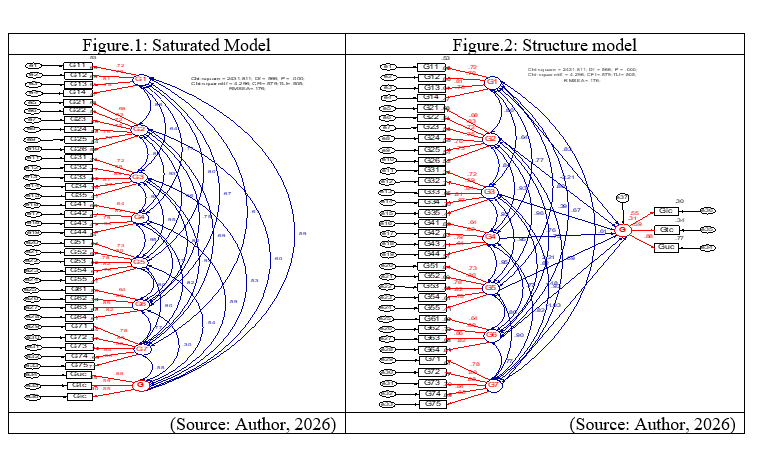
2) Results of testing the training program through a measurement model |-1<k<1|: The measurement model met the requirements of the general reliability and the total variance extracted> 0.50, there was no correlation between the errors of the measurement variables (items), so they achieved uniqueness or unidirectional have a correlation coefficient between the components (items) of a large concept (chapter) are <1. Therefore, large concepts (chapters) that achieve discriminatory values, with estimated regressions, are all positive values ³ 0.55 indicates that all concepts are positively related and the values of P are less than 0.05, which means that the concepts are statistically significant a = 5% and achieve convergence value. General coverage: Model of measurement available Chi - square = 2431.811; Df = 0.566; P = 0.000; Chi - Square/df = 4.296; CFI = 0.579; TLI = 0.505; RMSEA = 0.176 Market information should be relatively compatible (see Figure 1).
3) Results of training program accreditation through the performance structure model in the form of equations: YG = 0.83X1 + 0.80X2 + 0.67X3 + 0.76X4 + 0.69X5 + 0.82X6 + 0.77X7
Contribution of chapters to learners: G1 = 15.54%; G2 = 14.98%; G3 = 12.55%; G4 = 14.23%; G5 = 12.92%; G6 = 15.36%; G7 = 14.42%; average level of study: 0.76 either 76% average rating is quite good; Average level of teaching: 0.88 either 88% ranked pretty; difference between teaching: 0.88 - 0.76 = 0.12 either 12% equivalent to 1 rank. (see Figure 2).
5. Conclusion
1) The method of developing a curriculum based on the 6-level competency scale of Bloom has so far been popular in many advanced and developed countries. Applying this scale to build standard competencies and assessing learners, teachers definitely bring practical effects for lecturers to build training programs at all levels in educational and non-business units. created in Vietnam in the current context. However, any scale has its limitations, so this study adds another level of creativity to the Bloom 7 level extension.
2) The training program is built based on the learners' standards that are suitable for reality and practice: In the material synthesized, analyzed, evaluated, compared, selected scientifically. In the volume surveyed with Bloom's scale expanded 7 levels, the next official survey with the 7-point Likert scale. In the quality testing section, performing testing, analyzing EFA discovery factor through SPSS data analysis software, ML maximum method is used for CFA affirmative factor analysis in measurement model and SEM linear structure model through AMOS data structure software for teaching results compatible with financial market information or suitable for teachers and learners.
3) Research has presented a number of technical factors when developing a program based on learners 'output standards and evaluating learners' learning process based on capacity development. Building standard competencies is the top job of teachers. From the standard competencies, it is possible to set up the training objectives, establishing the overall training program. The development of standard competency assessments is a complex scientific task that must be developed and seriously conducted by a research team in order for the training program to be truly effective.
References
Bloom, B. S. (1956). Taxonomy of educational objectives, handbook I: The cognitive domain. David McKay Co. Inc.
Gronlund, N. (1991). How to write and use instructional objectives. McMillan Publishers.
Likert, R. A. (1932). A technique for the measurement of attitudes. Archives of Psychology.
Mishkin, F. S., & Eakins, S. G. (2015). Financial markets and institutions. East Carolina University.
Nguyen, N. T. (2025a). Financial markets. Faculty of Finance and Accounting, Industrial University of Ho Chi Minh City.
Nguyen, N. T. (2025b). Simulation of the experience teaching method for finance market. Journal of Finance and Accounting Research Vietnam. ISSN 2588-1493.
Nguyen, N. T. (2025c). Using digital technology to standardize accounting information systems. International Journal of Advanced and Applied Sciences. EISSN 2313-3724; Print ISSN 2313-626X.
Nguyen, N. T. (2026). Establishing a set of theoretical criteria to build a dynamic competitive structure model for enterprises in the financial market. Risk Governance and Control: Financial Markets & Institutions, 16(2), 144–154. https://doi.org/10.22495/rgcv16i2p13
Pohl, M. (2000). Learning to think, thinking to learn: Models and strategies to develop a classroom culture of thinking. Hawker Brownlow.
Phương pháp xây dựng chương trình đào tạo thị trường tài chính theo chuẩn đầu ra của người học
TS.Nguyễn Nam Thắng - ThS.Ngô Thị Hương
Trường Đại học Thủy Lợi Phân hiệu miền Nam
Tóm tắt:
Nghiên cứu này nhằm nhấn mạnh tầm quan trọng của việc chuẩn hóa hoạt động phát triển và đánh giá năng lực trong các chương trình đào tạo ở mọi cấp học. Nghiên cứu làm rõ các khái niệm, mục tiêu, câu hỏi trọng tâm và cách vận dụng thang nhận thức của Bloom để xây dựng tiêu chuẩn đánh giá năng lực người học và giảng viên. Dữ liệu được thu thập thông qua khảo sát sử dụng thang Likert, được xây dựng dựa trên thang nhận thức của Bloom và phân tích bằng Microsoft Excel, SPSS và AMOS. Kết quả nghiên cứu cung cấp tài liệu tham khảo thiết thực cho giảng viên trong việc thiết kế các chương trình đào tạo theo định hướng phát triển năng lực, phù hợp với Việt Nam và có thể điều chỉnh cho các bối cảnh giáo dục khác.
Từ khóa: Người học, chuẩn đầu ra, giảng viên, chất lượng giảng dạy, chương trình đào tạo.
[Tạp chí Công Thương - Các kết quả nghiên cứu khoa học và ứng dụng công nghệ, Số 19 năm 2026]