





ABSTRACT
This study evaluates the factors influencing students’ choice of Civil Engineering Technology as a major at Tra Vinh University in the context of a volatile real estate market. Using a five-point Likert-scale survey and descriptive statistical analysis conducted with Microsoft Excel, the study examines five key groups of factors: personal passion, social influence, university reputation, career prospects, and market and infrastructure fluctuations. The findings clarify the influence of each factor and students’ expectations regarding local infrastructure projects, thereby providing a basis for proposing improved enrollment strategies and curriculum adjustments aligned with labor market realities.
Keywords: civil engineering, Tra Vinh University.
1. Introduction
The construction sector serves as the "backbone" of the economy, playing a vital role in the processes of industrialization and modernization. According to the 2025 report by the General Statistics Office (GSO), the Ministry of Construction achieved an impressive growth rate exceeding 9%. Economic sectors managed by the Ministry are estimated to account for approximately 17.23% of the national GDP, a 0.17 percentage point increase compared to 2024 [1]. This contribution, representing about 1.96 percentage points of the total national GDP, was instrumental in helping Vietnam's economy achieve a growth rate of over 8% in 2025, solidifying the construction industry's role as a primary pillar. In the Mekong Delta region, the demand for high-quality technical human resources is rising sharply to support inter-regional infrastructure projects. A prime example is the implementation of the Dai Ngai Bridge Project connecting Tra Vinh and Soc Trang (currently Vinh Long – Can Tho) with a total investment exceeding 8 trillion VND [2], which has generated immense demand for a local engineering workforce.
However, in recent years, the Civil Engineering field has faced significant challenges due to the volatility of the real estate market. According to reports from the Ministry of Construction, the number of newly licensed commercial housing projects in 2023 decreased by 31% compared to 2021. Furthermore, the supply of off-plan housing eligible for sale in 2023 dropped by 27% compared to 2022 [3], leading to a hesitant mindset among both the labor force and prospective students. An inevitable consequence of this trend is a shift in career choices among high school students. Statistics from the Ministry of Education and Training in 2023 indicate that while Information Technology and Economics sectors experienced robust growth, the Construction and Architecture group saw enrollment application rates among the lowest in the technical fields [4].
As a multidisciplinary hub in the Mekong Delta, Tra Vinh University (TVU) has faced enrollment fluctuations despite its accredited quality. This study investigates the key factors driving students to choose the Civil Engineering Technology major at TVU amidst a volatile real estate market – a research gap particularly relevant to a province undergoing rapid infrastructure development. The findings aim to help TVU refine its recruitment strategies and realign its curriculum with market demands, effectively preparing for the construction industry's projected recovery during the 2025–2030 period.
2. Overview and research methodology
2.1. Research subjects and scope
The study identifies factors influencing the decision to major in Civil Engineering Technology among students at Tra Vinh University, with data collected from freshmen to seniors to ensure a multidimensional perspective. The research focuses on evaluating five key factor groups: personal passion, social influence, university reputation, career prospects, and the impact of real estate market fluctuations alongside local public investment. Conducted at the College of Engineering and Technology, the study utilized primary data gathered through both online and face-to-face surveys between March and April 2026.
2.2. Overview of research in Vietnam
To demonstrate that this topic is both a continuation of previous research and contains novel elements, the author synthesized representative studies in Vietnam on similar subjects conducted between 2009 and 2024. These studies, such as those by Tran & Cao [5], Nguyen et al. [6], and more recently Bui & Ha [7] and Pham [8], primarily focused on high school students or freshmen across various regions, including Quang Ngai, Phu Yen, Hanoi, and Ho Chi Minh City. Commonly identified influential factors across these works include personal characteristics, self-efficacy, institutional reputation, communication strategies, and the influence of family and social relationships. However, this synthesis reveals that prior research has yet to sufficiently address the impact of specific macroeconomic variables, such as real estate market fluctuations or local public investment projects, on major selection decisions, thereby establishing the research gap that this study aims to fulfill.
2.3. Research gaps and proposed survey model
While previous literature focuses on intrinsic and institutional factors, there is a lack of research on how real estate market volatility impacts Civil Engineering major selection, especially in developing regions like Vinh Long. To address this, the author proposes a model comprising five factor groups: Personal Characteristics (passion and compatibility), Social Influence (family and educators), Career Prospects (income and stability), University Branding (fees, location, and quality), and a novel variable—Real Estate Market Fluctuations (market trends, industry news, and key infrastructure projects).
2.4. Research methodology and data analysis
The study followed a two-phase process: survey instrument design and empirical data analysis. Utilizing a non-probability sampling technique, primary data were collected from Civil Engineering Technology students at Tra Vinh University via Google Forms distributed through Zalo groups. The questionnaire consisted of demographic inquiries and a 5-point Likert scale (from 1: Strongly Disagree to 5: Strongly Agree) to quantify five groups of influential factors. Collected data were then screened for validity, excluding any duplicate or incomplete responses prior to processing.
Data analysis was performed using Microsoft Excel, focusing on descriptive statistical techniques. Frequency and percentage statistics were utilized to illustrate sample characteristics, while mean analysis served as the core method to rank factor importance based on defined intervals (from Very Unimportant to Very Important). By comparing mean scores across groups, the most influential factors were identified, allowing for a synthesized discussion that correlates numerical results with the local practical context to formulate relevant recommendations.
3. Research results and discussion
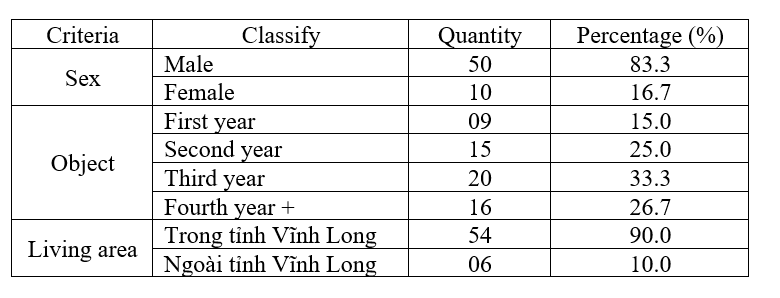
After conducting the online survey, the study collected 60 valid responses. The characteristics of the survey sample are summarized in Table 1. The sample showed a predominantly male distribution (83.3%), consistent with the characteristics of the engineering field. The relatively even participation of students from years 1 to 4 contributed to the objectivity and diversity of the data.
Table 1. Demographic characteristics of the survey sample
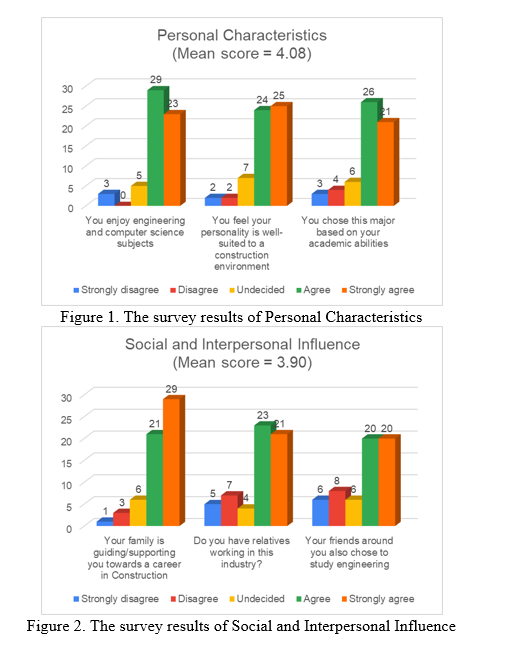
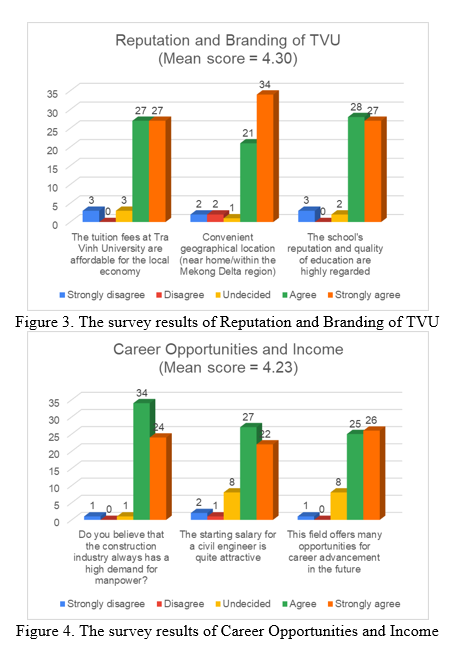

The analysis from Figures 1 to 5 of the five factor groups reveals a high level of consensus among students, with 'University Reputation and Branding' achieving the highest mean score (4.30) due to strategic location and affordable tuition, followed closely by 'Career Opportunities and Income' (4.23). While 'Personal Characteristics and Passion' (4.08) reflects a clear individual orientation, the 'Real Estate Market Fluctuations' group (4.04) shows that students remain optimistic despite market volatility, buoyed by major local infrastructure projects like the Dai Ngai Bridge. Conversely, 'Social and Interpersonal Influence' received the lowest score (3.90), indicating a growing trend of autonomy in career decision-making among the younger generation, who prioritize institutional quality and professional prospects over traditional external pressures.
To provide an overview, the study compared the mean values among five groups of factors:
Table 2. Compare the mean values of the factor groups
|
Rank |
Factor |
Mean value |
The level of influence on the decision to choose a major |
|
1 |
Reputation and Branding of Tra Vinh University |
4.30 |
Very important |
|
2 |
Career Opportunities and Income |
4.23 |
Very important |
|
3 |
Personal Characteristics |
4.08 |
Important |
|
4 |
Real Estate Market Fluctuations |
4.04 |
Important |
|
5 |
Social and Interpersonal Influence |
3.90 |
Important |
As shown in Table 2, the differences between the factor groups are marginal. The most influential factor in students' decision-making is 'Reputation and Branding of Tra Vinh University', followed by 'Career Opportunities and Income'. This indicates that when choosing a major in Civil Engineering Technology, students continue to prioritize educational quality and career prospects. Furthermore, the 'Real Estate Market Fluctuations' factor ranks fourth at an 'Important' level, proving that learners have recognized a specific correlation between the 'real estate crisis' and 'opportunities within the infrastructure construction sector.' This is a positive signal, reflecting the growing maturity in TVU students' perceptions regarding macroeconomic fluctuations.
4. Conclusion and recommendations
4.1. Conclusion
This study identifies the key factors influencing the decision to major in Civil Engineering Technology at Tra Vinh University amidst a volatile real estate market, revealing that while all five factor groups exert relatively equal influence, 'University Reputation and Branding' is the primary driver due to its strategic location and affordable tuition. Additionally, the significant impact of 'Career Opportunities and Income' confirms that future employment remains a top priority for students. Notably, despite the current housing market stagnation, students maintain optimism regarding 'Real Estate Market Fluctuations', a sentiment bolstered by their confidence in robust local infrastructure and renewable energy developments such as the Dai Ngai Bridge and various wind power projects.
4.2. Recommendations
To enhance enrollment and training effectiveness at Tra Vinh University, the author recommends updating communication strategies to emphasize public investment and green construction, strengthening early career orientation through site visits to local projects, and integrating BIM and infrastructure management into the curriculum to improve labor market flexibility. Furthermore, fostering university-enterprise ties through CO-OP programs is essential for securing student career paths. While providing valuable insights, this study is limited by its convenience sampling and restricted sample size; therefore, future research should expand the survey scope to other regional universities and employ advanced analytical models, such as multiple regression analysis, to more precisely evaluate the impact of each factor.
References
Bui, C. V., & Ha, N. T. (2024). Factors affecting university selection decisions of universities in Hanoi city. Journal of Education, 24(1), 42 - 47.
Government Online Newspaper. (2026). Supply is increasing but house prices haven’t fallen. https://baochinhphu.vn/nguon-cung-tang-gia-nha-chua-giam-102260117005432583.htm
Nguyen, M. H., Huynh, G. X., & Huynh, T. K. T. (2011). Research on factors influencing students’ choice of Ho Chi Minh City Open University. Ho Chi Minh City Open University Journal of Science, 2(6), 107–117.
Pham, T. H. (2024). Research on factors influencing the decision of choosing a university by students of the University of Transportation, Ho Chi Minh City branch. Journal of Economics and Business Administration, 31, 40 - 46.
Thanhnien Online. (2023). University admissions 2023: Leading majors in terms of the number of applicants. https://thanhnien.vn/tuyen-sinh-dh-2023-nhung-nganh-dan-dau-so-luong-thi-sinh-dang-ky-185230817164747867.htm
Tran, V. Q., & Cao, H. T. (2009). Factors influencing high school students’ decisions on choosing a university. Journal of Science and Technology Development, 12(15), 87 - 102.
VnExpress Online. (2023). Construction of an 8 trillion VND bridge across the Hau River will begin in October. https://vnexpress.net/khoi-cong-cau-8-000-ty-dong-bac-qua-song-hau-vao-thang-10-4655121.html
VTV Online. (2025). The Ministry of Construction has achieved its growth target of over 9%. https://vtv.vn/bo-xay-dung-hoan-thanh-muc-tieu-tang-truong-tren-9-100251221100932615.htm
Các yếu tố ảnh hưởng đến quyết định của sinh viên trong việc lựa chọn ngành Công nghệ kỹ thuật xây dựng công trình tại Đại học Trà Vinh trong bối cảnh thị trường bất động sản có nhiều biến động
Cao Hữu Lợi1
Trần Thanh Vũ1
1Trường Kỹ thuật và Công nghệ, Đại học Trà Vinh
Tóm tắt :
Nghiên cứu này đánh giá các yếu tố ảnh hưởng đến quyết định của sinh viên trong việc lựa chọn ngành Công nghệ kỹ thuật xây dựng công trình tại Đại học Trà Vinh trong bối cảnh thị trường bất động sản có nhiều biến động. Thông qua khảo sát theo thang đo Likert 5 mức độ và phương pháp thống kê mô tả với Microsoft Excel, nghiên cứu phân tích 05 nhóm yếu tố chính, bao gồm: niềm đam mê cá nhân, ảnh hưởng xã hội, uy tín của nhà trường, triển vọng nghề nghiệp, và biến động của thị trường bất động sản cũng như cơ sở hạ tầng xây dựng. Kết quả nghiên cứu làm rõ mức độ ảnh hưởng của từng yếu tố và kỳ vọng của sinh viên đối với các dự án xây dựng hạ tầng tại địa phương, qua đó làm nền tảng cho các đề xuất nâng cao hiệu quả chiến lược tuyển sinh của Đại học Trà Vinh và điều chỉnh chương trình đào tạo phù hợp với thực tiễn thị trường lao động.
Từ khóa : kỹ thuật xây dựng, Đại học Trà Vinh
[Tạp chí Công Thương - Các kết quả nghiên cứu khoa học và ứng dụng công nghệ, Số 13 năm 2026]