





TÓM TẮT:
The study investigates the impact of government debt on per capita GDP growth. The result shows that the government debt has significant and negative impact on the GDP growth. This result comes from data from 14 countries in 24 years starting in 1990. There are many studies about this topic and the results of these studies are not consistent. Some find that the government debt has positive effect the GDP growth rate while some others find that the government debt has negative effect the growth rate of the GDP. The result from this study provides more insight into this field of study. This study also finds a significant impact of the other factors on the per capital GDP growth: export, foreign direct investment, and government spending.
Keywords: Government debt, economic growth.
1. Introduction
There are different theories and studies about the effect of the government debt on the GDP growth. It suggests that the government debt is a crucial source of support for the economy; therefore, government debt helps to improve the GDP growth. However other theories and studies argue that the government debt also negatively impacts the GDP growth because when the level of the government debt is high, the pressure to pay back debt and the interest rate for the government debt is high. This increases the cost for the economy and the potential negative effect on the GDP growth.
2. Literature review
There are many theories about the relationship between the government debt and the GDP growth. Modigliani (1961) argued that the higher level of the government debt causes a lower level of the private loan and a higher pressure of loan for the later generation. He also argued that the higher level of the government debt causes a higher level of the interest rate because a higher level of capital demands from the public sector. This consequently crowds out the GDP.
Diamond (1965) argued when the government debt is high, the government has to raise tax. As a result, the capital stock and consumption of the people decrease. This is because when the government debt is high, the government has to pay interest and principal. The result is that the government has to increases tax, which lowers the consumption of the consumers and their capital stock.
Adam and Bevan (2005) discovered that there is a relationship between the national debt and the government deficit. They argued that a higher government debt causes a higher government deficit. This is because the government must use its budget to pay for the debt. The budget deficit in turn causes a higher level of the government debt. This process forces the country to face more problems.
Saint-Paul (1992) and Aizenman et al. (2007) discovered the negative relationship between the government debt and GDP growth. [what negative relationship? Need to explain this in more detail.].
Aschauer (2000) argued that there is an ideal level of the government debt. if the government can keep the its debt below this level, the GDP growth will increase; if the government debt is above this level, the GDP growth will decrease.
Meade (1958) suggested that if the government debt can be kept below a given level, the people will save more, gives households and firms will have more incentives [incentive to do what? Buy more? Save more?], and income tax will lower.
Elmendorf and Mankiw, 1999 argued that long term interest rate from the government debt because of the budget deficit crowds out private investment and badly impacts the GDP growth. They claim that a higher government debt and budget deficit cause an outflow of the private capital into the public debt. This causes a higher interest rate in the private sector and decreases the private spending on both the households and the firms.
Patillo et al. (2004) suggested that the high government debt can badly impact on the future of policy. The government with higher debt level struggles with the future policy of the investment. This causes a bad effect on the GDP growth.
There are also some empirical studies about the relationship between the government debt and GDP growth. Pattillo et al. (2002) used dataset from 93 countries from developing countries from 1960 to 1998 and found a non-linear relationship between the government debt and the GDP growth. It also found that when the ratio between the debt to GDP is higher than 39-40%, the relationship between the government debt and the GDP growth is negative. Clements et al. (2003) investigated the same phenomenon by studying 55 low income countries from 1970 to 1999 and found that the threshold is 20-25%. The finding from these two research groups is supported by Smyth and Hsing (1995) and Cohen (1997), who also found a non-linear effect of the government debt on the GDP growth. In contrast, Schclarek (2004) found a linear relationship between the government debt and the GDP growth. Schclarek (2004) used data from 24 developed countries in a period of 32 years from 1970 to 2002 and found insignificant relationship between the government debt and the GDP growth. Reinhart and Rogoff (2010) used data that span two centuries (1790-2009) and found that there is a slight positive relationship between the government debt and long term growth when the threshold is below 90% of GDP; if the threshold is higher than 90% of GDP, there is a negative relationship.
3. Empirical model, data, and results
LnGDP = GDEBT + EXPORT + FDI + GSPEND
- Natural logarithm GDP is logarithm of GDP per capital. This is used as a proxy of economic growth
- Export is value of export as a share of GDP
- FDI is value of foreign direct investment
- GSPEND is expenditures of government as a share of GDP
This study uses data from 14 countries: Spain, United Kingdom, Guatemala, India, Iceland, Jordan, Malta, Mauritius, Netherlands, Norway, Singapore, Thailand, Tunisia, and United State of America. The time period of data is 24 years from 1992 to 2015.
Test results for collinearity and homoscedasticity are presented in appendix. These results show that the assumptions about collinearity and homoscedasticity are correct and we can conduct the multiple regression test for this study.
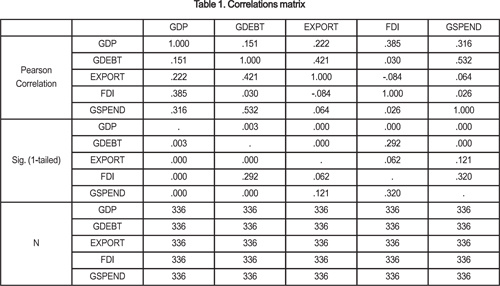
The correlation matrix is presented in the above table. This shows that the variables in this model are correlated. Therefore, we can use this model to find the significance of this relationship.
a. Dependent Variable: GDP
a. Dependent Variable: GDP
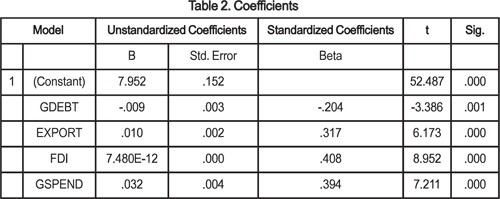
The results of the multiple regression test show that all variables in this model have a significant effect on the GDP growth and that the government debt has a significant and negative effect on the GDP growth. This result is consistent with some of the previously mentioned studies.
We also see other significant effects on the GDP growth: The export, FDI, and government expenditure have a significant and positive effect the GDP growth.
4. Conclusion
The result of study shows that with a dataset from 14 developed and developing countries in a period of 24 years from 1992 to 2015, there is a significant and negative relationship between the government debt and the GDP growth.
We also found significant and positive relationships between the GDP growth and the export, FDI, and government expenditure.
REFERENCES:
1. Adam, C. S. and D. L. Bevan(2005), “Fiscal deficits and growth in developing countries”, Journal of Public Economics, Vol. (4), pp. 571-597.
2. Aizenman, J., K. Kletzer and B. Pinto (2007), Economic growth with constraints on tax revenues and public debt: implications for fiscal policy and cross-country differences, NBER Working Paper 12750.
3. Aschauer, D. A.(2000). "Do states optimize? Public capital and economic growth." The Annals of Regional Science, 34(3), pp343-363.
4. Clements, B., R. Bhattacharya and T. Q. Nguyen (2003), External debt, public investment, and growth in low-income countries, IMF Working paper 03/249.
5. Cohen, D. (1997), Growth and external debt: A new perspective on the African and Latin American tragedies, Centre for Economic Policy Research Discussion Paper No. 1753.
6. Diamond, P.(1965), “National Debt in a Neoclassical Growth Model”, American Economic Review, 55(5), pp. 1126-1150.
7. Elmendorf, D. and N. Mankiw (1999). “Government Debt”, in Taylor, J. and Woodford, M. (eds.), Handbook of Macroeconomics, vol. 1C, 1615-1669, North-Holland.
8. Meade, J. E. (1958), “Is the National Debt a Burden?” Oxford Economic Papers, New Series, Vol. 10(2), pp. 163-183.
9. Modigliani, F. (1961), “Long-Run Implications of Alternative Fiscal Policies and the Burden Of the National Debt”, Economic Journal, 71 (284), pp. 730-755.
10.Pattillo, C., H. Poirson, and L. Ricci (2002), External Debt and Growth, IMF Working Paper 02/69.
11. Reinhart, C.M. and K. S. Rogoff (2010), “Growth in a Time of Debt”, NBER Working Paper No. 15639.
12. Saint-Paul, G. (1992), “Fiscal policy in an Endogenous Growth Model”, Quarterly Journal of Economics, No. 107, pp. 1243-1259.
13. Schclarek, A. (2004), Debt and Economic Growth in Developing Industrial Countries, mimeo.
14. Smyth, D. and Hsing, Y.(1995), “In search of an optimal debt ratio for economic growth”, Contemporary Economic Policy, 13:51-59.
PhD. CAO MINH MAN (Associate Dean, Business School - International University, Vietnam National University, HCMC)
ẢNH HƯỞNG NỢ CỦA CHÍNH PHỦ ĐẾN TĂNG TRƯỞNG KINH TẾ: ĐIỀU TRA THỰC NGHIỆM TỪ 14 QUỐC GIA
TS. CAO MINH MẪN
Khoa Quản trị kinh doanh, Trường Đại học Quốc tế, Đại học Quốc gia, TP. Hồ Chí Minh
TÓM TẮT:
Nghiên cứu tìm hiểu ảnh hưởng của nợ chính phủ đến tăng trưởng GDP trên đầu người. Kết quả chỉ ra rằng, nợ chính phủ ảnh hưởng đáng kể và tiêu cực đến tăng trưởng GDP. Kết quả này có đựơc từ số liệu của 14 quốc gia trong vòng 24 năm, kể từ năm 1990. Có nhiều nghiên cứu về đề tài này nhưng kết quả của những nghiên cứu này không thống nhất. Một số nghiên cứu kết luận rằng, nợ chính phủ ảnh hưởng tích cực đến tăng trưởng GDP; trong khi một số nghiên cứu khác kết luận rằng nợ chính phủ gây ra ảnh hưởng tiêu cực đến tăng trưởng GDP. Nghiên cứu này góp phần làm sáng tỏ hơn lĩnh vực cứu này, đồng thời cùng tìm ra ảnh hưởng đáng kể của một số nhân tố khác đến tăng trưởng GDP trên đầu người: xuất khẩu, đầu tư trực tiếp nước ngoài và chi tiêu của chính phủ.
Từ khóa: Nợ chính phủ, tăng trưởng kinh tế.
Xem tất cả ấn phẩm Các kết quả nghiên cứu khoa học và ứng dụng công nghệ số 07 tháng 06/2017 tại đây