




ABSTRACT:This study aims to develop a processing method for producing low-fat, ready-to-eat fish balls from bronze featherback fish through two pre-frying treatments: drying and ultrasound. Both approaches are designed to reduce oil absorption during frying, thereby enhancing nutritional quality and aligning with health-oriented consumption trends. The drying treatment was evaluated based on fish ball diameter, temperature, and drying time, with optimal conditions identified at a diameter of 3 cm, drying at 70°C for 20 minutes, resulting in a reduced fat content of 8.17%. For the ultrasound treatment, the investigated parameters included sample diameter, temperature, and treatment duration, with optimal conditions of a 2.5 cm diameter, ultrasound temperature of 70°C, and a treatment time of 20 minutes, achieving a lower fat content of 5.33%. The results demonstrate that both pre-treatment methods effectively reduce fat content while preserving desirable sensory attributes, highlighting their potential for application in the production of healthier fried food products.Keywords: drying, fat content, fish balls, oil absorption, ultrasound.
1. Introduction
Fish balls are a widely consumed and convenient food product in Vietnamese cuisine. However, the conventional deep-frying process results in elevated fat content in products which may significantly affect consumers' health [1]. The development of technologies to reduce oil absorption while maintaining the sensory properties has become a critical challenge in the food industry. In recent years, pre-frying treatments such as drying and ultrasound have received attention for their ability to effectively reduce oil absorption in fried foods [2, 3].
The majority of the oil absorption occurs after frying rather than during frying [4, 5]. Reducing oil absorption has become a central focus in developing healthier fried foods.
It has been demonstrated that drying temperature and duration are key factors influencing the reduction of oil uptake, with optimal conditions for porous matrices such as potatoes or fish being 70–75°C for 3–4 minutes [3, 6]. Ultrasound has been reported to generate cavitation the repeated formation and implosion of microbubbles which modifies the microstructure of the food surface and promotes the development of micropores [2].
This study was conducted to evaluate the efficiency of drying and ultrasound as pre-frying treatments for reducing fat content in fish balls. The investigated process parameters include sample diameter, temperature, and treatment time.
2. Materials and methods
2.1. Material
The featherback fish (Notopterus notopterus) used in this study was fresh raw material that had been pretreated and mixed with ground pork paste. The fish samples were purchased from Tan Tru Market, Tan Son Ward, Ho Chi Minh City. After collection, the samples were stored in a refrigerator at approximately 4°C and used within the same day to ensure freshness and raw material quality for the experimental procedures. The chemicals used in the study included NaCl (solid form, 99% purity, China) and hexane (liquid form, 99% purity, China). All equipment used belonged to the food Science and Technology Laboratory, Ho Chi Minh City University of Food Industry.
2.2. Effect of fish ball diameter, drying temperature and drying time on fat content with drying as pre-frying treatment
Fish balls were formed into 5 diameters (1.5, 2, 2.5, 3, and 3.5cm), dried at 70°C for 5 minutes, and deep-fried. After frying, samples were ground and dried at 105°C to constant weight. Then, 2.00g of each sample was placed into a filter paper and inserted to a Soxhlet apparatus, and the fat was extracted with hexane for 4–6 hours. The extracted samples were dried to constant weight to complete evaporation of the solvent and moisture. The fat extraction efficiency was evaluated by determining fat content and comparing the dried samples with the control sample (fried without drying).
Drying temperature was investigated at 60°C, 70°C, 80°C, 90°C, and 100°C with the optimal diameter of fish ball obtained previously and drying time of 5 minutes. After drying, the sample was deep-fried. The fried samples were ground and dried to constant weight at 105°C. The fat content was then determined using the Soxhlet extraction method.
Drying time was investigated at 5, 10, 15, 20, and 25 minutes. After drying, all subsequent steps followed the procedures described in the previous experiments. The fat content of the drying-assisted sample was compared with the control sample (fried without drying).
2.3. Effect of fish ball diameter, ultrasound temperature and ultrasound time on fat content with ultrasound as pre-frying treatment
Fish ball samples were prepared with diameters of 1.5, 2.0, 2.5, 3.0, 3.5, and 4.0cm, treated by an ultrasonic bath at 40°C for 15 minutes prior to deep-fried. The fried samples were cooled, ground, and dried at 105°C to constant weight. Accurately weigh 2.00 g of the sample and determine the fat content using the Soxhlet extraction method.
Ultrasound temperature was examined at 40°C, 50°C, 60°C, 70°C and 80°C. The fish ball diameter in this experiment was based on the optimal results identified previously. The ultrasound treatment time was kept constant at 15 minutes. After ultrasound treatment, the samples were deep-fried, and fat was extracted using the Soxhlet method described earlier with hexane as solvent.
Ultrasound time was investigated at 5 minutes, 10 minutes, 15 minutes, 20 minutes, and 25 minutes. The fish ball diameter and ultrasound temperature were selected based on the optimal results from the previous experiments. After each ultrasound treatment, the samples were fried and analysed as described previously.
2.4. Determination of fat content
Fat content was determined using Soxhlet extraction method, a popular extraction method in analytical chemistry. Sample was first dried to constant weight, then 2.00 g of each dried sample was placed into the filter paper and inserted to the Soxhlet apparatus with hexane as solvent. Heating was applied to evaporate the solvent and continuous extraction for 4-6 hours. After extraction, samples were dried to constant weight to allow hexane and moisture completely evaporated.
Calculating fat content (%) was calculated using equation:
X% = (m1 - m2)/m1 x 100%
In which: X: Fat content (%),
m1: Sample weight before extraction (g),
m2: Sample weight after extraction and drying to constant weight (g).
2.5. Data processing method
In this study, all experiments were performed in triplicate, and the results were presented as mean values. The analysis results between experimental samples were evaluated by analysis of variance (ANOVA) at a significant level of α = 0.05 using Minitab Statistical Software. Least Significant Difference (LSD) test was conducted following the ANOVA to determine specific treatment pairs exhibiting statistically significant differences.
3. Results and discussion
3.1. Effect of fish ball diameter, drying temperature and drying time on fat content with drying as pre-frying treatment
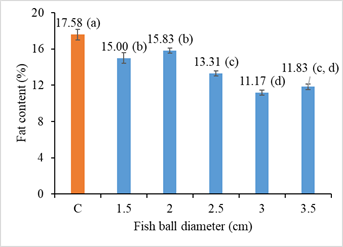
The surface area to volume ratio is a decisive factor that determines moisture evaporation rates and formation of the product’s microstructure [8]. Figure 1 indicates that the fat content of fish balls varied depending on the diameter. The samples with a diameter of 2 cm absorbed the highest fat (15.83%), which was 4.66% higher than the 3 cm samples (11.17%). The lowest fat content was the 3 cm fish balls (11.17%), followed by the 3.5 cm samples (11.83%). Larger samples such as 3–3.5 cm retain moisture effectively during drying, forming a relatively stable anti-permeable surface layer and reducing the capillary force of oil absorption after frying [9]. The 3 cm sample after drying reduced 6.41% compared to the control sample. Therefore, 3 cm diameter fish ball samples were selected as a fixed factor for the subsequent experiments.
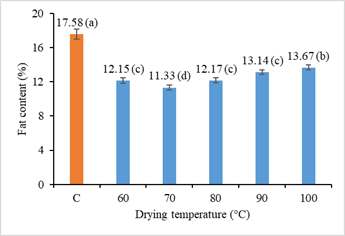
Pre-drying reduces the surface moisture, leading to reduce oil absorption by limiting the oil diffusion into the product through the capillaries. The results in Figure 2 show that the fat content changes significantly with the drying temperature. As compared to the control sample (17.58% fat), all pre-drying samples have significantly lower fat content. At 70°C, the fat content was the lowest (11.33%), 1.6 times lower than the control sample. Drying at 100°C resulted in the highest fat content (13.67%) among the pre-drying samples. This may be due to excessively high drying temperature causes surface microstructure damage [8, 9] leading to increased oil absorption during frying [3, 8] . This aligns with the study of Karacabey et al. about pre-drying carrot [10]. Based on this result, the drying temperature of 70°C was identified as the most optimal parameter and was selected to conduct further research.
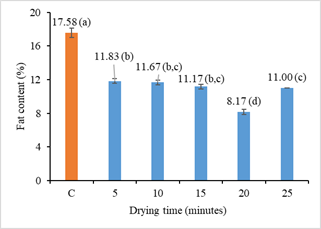
Longer drying time promotes moisture reduction, leading to decreased fat absorption [6]. As shown in Figure 3, when drying time was 5 minutes, the fat content was highest (11.83%) among other dried samples. The lowest fat content (8.17%) was observed in the sample with a drying time of 20 minutes- a reduction of 9.41% compared to the control sample. The fat content at 25 minutes increased slightly to 11%, due to excessive drying time leads to alterations in product structure and impacts oil absorption during frying. Therefore, a drying time of 20 minutes was identified as optimal to reduce the fat absorption of fish balls.
Figure 1. Effect of fish ball diameter (a), drying temperature (b) and (c) drying time on fat content. Different letters (a–d) indicate significant differences (p < 0.05).
a)
 c)
c)
3.4. Effect of fish ball diameter, ultrasound temperature and ultrasound time on fat content with ultrasound as pre-frying treatment
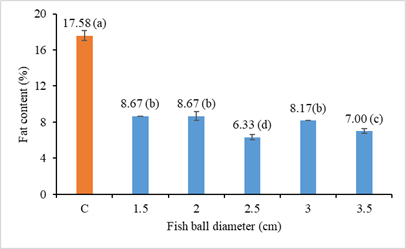
In theory, smaller sizes have a higher surface area to volume ratio, allowing increased interaction with ultrasound waves, forming small capillaries, promoting moisture evaporation, and limiting oil absorption during frying [2]. As shown in Figure 4, the 2.5 cm diameter sample achieved the lowest fat content (6.33%), all ultrasound-assisted samples had significantly lower fat content than the control, confirming the fat reduction efficiency of this method. This can be explained by the distribution of ultrasound waves and the different levels of tissue damage. However, excessively small or large samples caused adverse effects due to uneven ultrasound energy distribution. This finding aligns with previous research about vacuum-fried Pleurotus eryngii [7]. Therefore, a diameter of 2.5 cm was considered the optimal diameter to reduce oil absorption and was selected for the subsequent experiments.
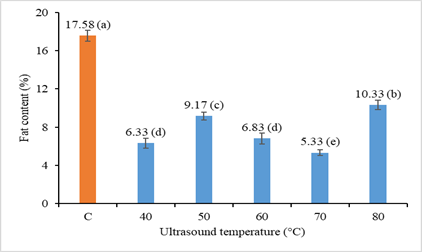
Ultrasound as pre-frying treatment is recognized for reducing oil absorption through cavitation, which alters the microstructure, such as protein network and porosity structure [11]. As shown in Figure 5, the control sample without ultrasound treatment had the highest fat content (17.58%). With ultrasound temperature of 50°C to 70°C, the fat content tended to decrease and reached the lowest at 70°C (5.33%). However, at 80°C, the fat content reached the highest (10.33%).This result is consistent with a previous study on potatoes, chicken, and mushrooms [2, 12]. When the temperature was excessively low (<40°C), the cell changed minimally, and the fat content decreased suboptimal. On the contrary, excessively high temperature (>70°C) caused protein denaturation or disrupted tissue structure, leading to increased oil absorption during frying. Based on this result, the ultrasound temperature of 70°C was the most optimal and was selected for subsequent experiments.
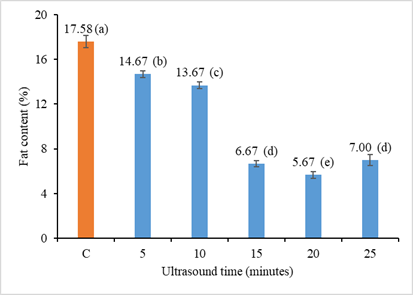
Longer ultrasound time increases cell disruption and tissue shrinkage; however, exceeding the threshold may cause excessive structural damage [12]. Figure 6 shows that the lowest fat content (5.67%) was at the sample treated with ultrasound for 20 minutes. In addition, the fat content was 14.67% with short treatment time (5 minutes) and showed substantial fat reduction with longer treatment time (from 15 to 25 minutes). This result is in agreement with previous research on ultrasound-assisted frying of sweet potatoes, where a processing time of 20 minutes was likewise identified as the optimal condition [11]. The consistency indicated that the generality of cavitation effects through biological materials. Overall, 20 minutes of ultrasound treatment was the optimal selection for the production of low-fat fried fish balls.
Figure 2. Effect of fish ball diameter (a), ultrasound temperature (b) and ultrasound time (c) on fat content. Different letters (a–e) indicate significant differences (p < 0.05).
REFERENCE:
1. Bouchon P. (2009). Understanding oil absorption during deep fat frying. Advances in Food and Nutrition Research, 57, 209-234. https://doi.org/10.1016/s1043-4526(09)57005-2.
2. Chemat F. and M.K. Khan (2011). Applications of ultrasound in food technology: Processing, preservation and extraction. Ultrasonics Sonochemistry, 18(4), 813-835. https://doi.org/10.1016/j.ultsonch.2010.11.023.
3. Moreira R.G., M.E. (1999). Castell-Perez, and M.A. Barrufet - Deep fat frying: Fundamentals and applications, Springer US, 350.
4. Lumanlan J.C., W.M.A.D.B. Fernando, and V. Jayasena (2019). Mechanisms of oil uptake during deep frying and applications of predrying and hydrocolloids in reducing fat content of chips. International Journal of Food Science and Technology, 55(4), 1661-1670. https://doi.org/10.1111/ijfs.14435.
5. Dana D. and I.S. Saguy (2006). Review: Mechanism of oil uptake during deep-fat frying and the surfactant effect-theory and myth. Advances in Colloid and Interface Science, 128-130, 267-272. https://doi.org/10.1016/j.cis.2006.11.013.
6. Sobukola, O. (2009). Effect of Pre-Treatment on the Drying Characteristics and Kinetics of Okra (Abelmoschus esculetis (L.) Moench) Slices. International Journal of Food Engineering, 5(2). https://doi.org/10.2202/1556-3758.1191.
7. Ren A. et al. (2022). Reduction of oil uptake in vacuum fried Pleurotus eryngii chips via ultrasound assisted pretreatment. Nutrition and Food Science Technology, 9. https://doi.org/10.3389/fnut.2022.1037652.
8. Saguy I.S. and D. Dana (2003). Integrated approach to deep fat frying: engineering, nutrition, health and consumer aspects. Journal of food engineering, 56(2-3), 143-152. https://doi.org/10.1016/S0260-8774(02)00243-1.
9. Mohammadpour Karizaki V. et al. (2013). Effect of Ultrasound-Assisted Osmotic Dehydration as a Pretreatment on Deep Fat Frying of Potatoes. Food and Bioprocess Technology, 6, 3554–3563. https://doi.org/10.1007/s11947-012-1012-5.
10. Karacabey E. et al. (2016). Optimisation of pre-drying and deep-fat-frying conditions for production of low-fat fried carrot slices. Journal of the Science of Food and Agriculture, 96(13), 4603-4612. https://doi.org/10.1002/jsfa.7678.
11. Oladejo A.O. et al. (2017). Effects of ultrasound pretreatments on the kinetics of moisture loss and oil uptake during deep fat frying of sweet potato (Ipomea batatas). Innovative Food Science & Emerging Technologies, 43, 7-17. https://doi.org/10.1016/j.ifset.2017.07.019.
12. Zhang J. et al. (2020). Effect of pore characteristics on oil absorption behavior during frying of potato chips. Innovative Food Science & Emerging Technologies, 66, 102508. https://doi.org/10.1016/j.ifset.2020.102508.
ỨNG DỤNG KỸ THUẬT SẤY VÀ SIÊU ÂM ĐỂ GIẢM CHẤT BÉO
TRONG SẢN XUẤT CHẢ CÁ THÁC LÁC
Nguyễn Trần Bảo Châu
Trường Đại học Công Thương Thành phố Hồ Chí Minh
Tóm tắt:
Nghiên cứu nhằm phát triển quy trình sản xuất chả cá viên ăn liền ít béo từ cá thác lác thông qua hai phương pháp xử lý nguyên liệu trước khi chiên là sấy và siêu âm. Cả hai phương pháp đều hướng đến mục tiêu giảm khả năng hấp thụ dầu trong quá trình chiên, qua đó nâng cao giá trị dinh dưỡng và đáp ứng xu hướng tiêu dùng thực phẩm lành mạnh. Quá trình sấy được khảo sát với 3 yếu tố: Kích thước đường kính viên, nhiệt độ và thời gian sấy. Kết quả cho thấy, với viên chả cá có đường kính 3 cm, sấy ở 70°C trong thời gian 20 phút giúp giảm hàm lượng chất béo xuống còn 8.17%. Đối với phương pháp siêu âm, các yếu tố khảo sát bao gồm: kích thước đường kính viên, nhiệt độ và thời gian xử lý. Kết quả là đường kính viên 2.5 cm, nhiệt độ 70°C và thời gian siêu âm 20 phút giúp giảm hàm lượng chất béo xuống còn 5.33%. Kết quả nghiên cứu khẳng định hiệu quả rõ rệt của cả hai phương pháp trong việc giảm hàm lượng chất béo cho sản phẩm, đồng thời vẫn duy trì chất lượng cảm quan sản phẩm. Đây là những hướng tiếp cận tiềm năng, khả thi và có thể ứng dụng rộng rãi trong phát triển các sản phẩm thực phẩm ít béo.
Từ khóa: chả cá viên, hấp thụ, chất béo, sấy, siêu âm.