




Abstract:
This study investigates the preparation and application of modified biochars derived from rice husk and sugarcane bagasse for the removal of crystal violet (CV) dye and Pb(II) ions from aqueous solutions. Four adsorbents, designated RH1, RH2, SG1, and SG2, were produced via carbonization followed by chemical activation of agricultural residues. Adsorption kinetics were evaluated using pseudo-first-order and pseudo-second-order models, with the latter providing a superior fit, particularly for Pb(II) removal (R² ≈ 0.9997–1.000). Structural and surface characterizations using FTIR and SEM analyses revealed that chemical activation enhanced surface heterogeneity and porosity, while functional groups played a key role in pollutant binding. The findings demonstrate that modified biochars derived from agricultural waste represent an efficient and low-cost adsorbent for the simultaneous removal of dyes and heavy metals from wastewater.
Keywords: biochar, rice husk, sugarcane bagasse, crystal violet, Pb(II), adsorption.
1. Introduction
Industrial effluents containing synthetic dyes and heavy metals remain a major environmental concern because these pollutants are persistent, toxic, and difficult to remove completely by conventional treatment methods. Synthetic dyes released from textile and related industries reduce light penetration, increase chemical oxygen demand, and may exert adverse effects on aquatic organisms and human health. Crystal violet (CV), a cationic triphenylmethane dye, is especially problematic because of its strong color intensity, resistance to biodegradation, and potential toxicity (Forgacs et al., 2004; Lellis et al., 2019). In parallel, lead is a non-biodegradable heavy metal that can accumulate in ecosystems and cause neurological, renal, and developmental disorders even at relatively low exposure levels.
Adsorption has been widely considered one of the most attractive treatment methods for both dyes and heavy metals because it is simple to operate, does not require sophisticated equipment, and can be implemented with low-cost solid materials. In recent years, biochar produced from agricultural residues has emerged as a promising adsorbent due to its carbon-rich structure, pore network, aromatic surface, and oxygen-containing functional groups. The adsorption performance of biochar depends strongly on feedstock type, pyrolysis conditions, and post-treatment or activation steps, all of which affect surface area, mineral content, ash composition, and the abundance of reactive functional groups (Ahmad et al., 2014; Mohan et al., 2014).
Rice husk and sugarcane bagasse are abundant agricultural residues in Vietnam and many other tropical countries. Their conversion into biochar offers a dual benefit: reducing solid-waste burden and generating a useful material for water treatment. Previous studies have shown that biochar can adsorb both organic pollutants and metal ions, including lead, from contaminated water (Liu & Zhang, 2009; Mohan et al., 2014). At the same time, adsorption behavior is commonly interpreted using kinetic and equilibrium models, with pseudo-second-order kinetics and classical isotherm models often providing valuable insight into adsorption mechanisms and capacity (Ho & McKay, 1999; Foo & Hameed, 2010).
In this study, modified biochar from rice husk and sugarcane bagasse was prepared and evaluated for the removal of CV and Pb(II) from aqueous solution. The work compares four adsorbent samples (RH1, RH2, SG1, and SG2), examines the effects of pH, dosage, contact time, temperature, and initial concentration, and interprets adsorption behavior using characterization observations and kinetic modeling.
2. Materials and methods
2.1. Raw materials and chemicals
The feedstocks were crushed, screened, and dried, then compacted before carbonization. The resulting chars were chemically activated, washed or adjusted to neutral pH, dried again, and preserved for subsequent experiments. The final products were coded RH1 and RH2 for the rice-husk-derived biochars and SG1 and SG2 for the sugarcane-bagasse-derived biochars.
2.2. Preparation of modified biochar
The feedstocks were processed according to the workflow reported in the thesis presentation. In brief, raw materials were crushed, screened, and dried, then compacted before carbonization. The resulting chars were further subjected to chemical activation, washed or adjusted to neutral pH, dried again, and preserved for subsequent experiments. The final products were coded RH1 and RH2 for the rice-husk-derived biochars and SG1 and SG2 for the sugarcane-bagasse-derived biochars.
2.3. Characterization and batch adsorption tests
A calibration curve was prepared for CV analysis, and the residual dye concentration was determined photometrically. Pb(II) concentration was determined by spectrometric analysis. FTIR spectra were used to evaluate changes in surface functional groups before and after adsorption, and SEM micrographs were used to examine morphological changes due to activation and contaminant uptake.
Batch adsorption tests were carried out to determine the effects of solution pH, adsorbent dosage, contact time, temperature, and initial concentration. The investigated pH range was approximately 4-8 for RH materials and 4-9 for SG materials, depending on the contaminant system. Adsorbent dosage was varied from 1 to 15 g/L. Contact time was studied up to 180-240 min, and the temperature effect was evaluated at 30, 40, and 45°C.
H (%) = [(C₀ − Cₑ) / C₀] × 100
qₑ (mg/g) = [(C₀ − Cₑ) × V] / m
where H is removal efficiency, qₑ is equilibrium adsorption capacity, C₀ and Cₑ are the initial and equilibrium concentrations of solute, V is the solution volume, and m is the mass of adsorbent.
2.4. Kinetic analysis
The adsorption data were interpreted using pseudo-first-order and pseudo-second-order kinetic models. Comparison between the calculated adsorption capacities and the experimental values, together with the coefficient of determination (R²), was used to identify the more suitable kinetic description for each adsorbent-pollutant system.
3. Results and discussion
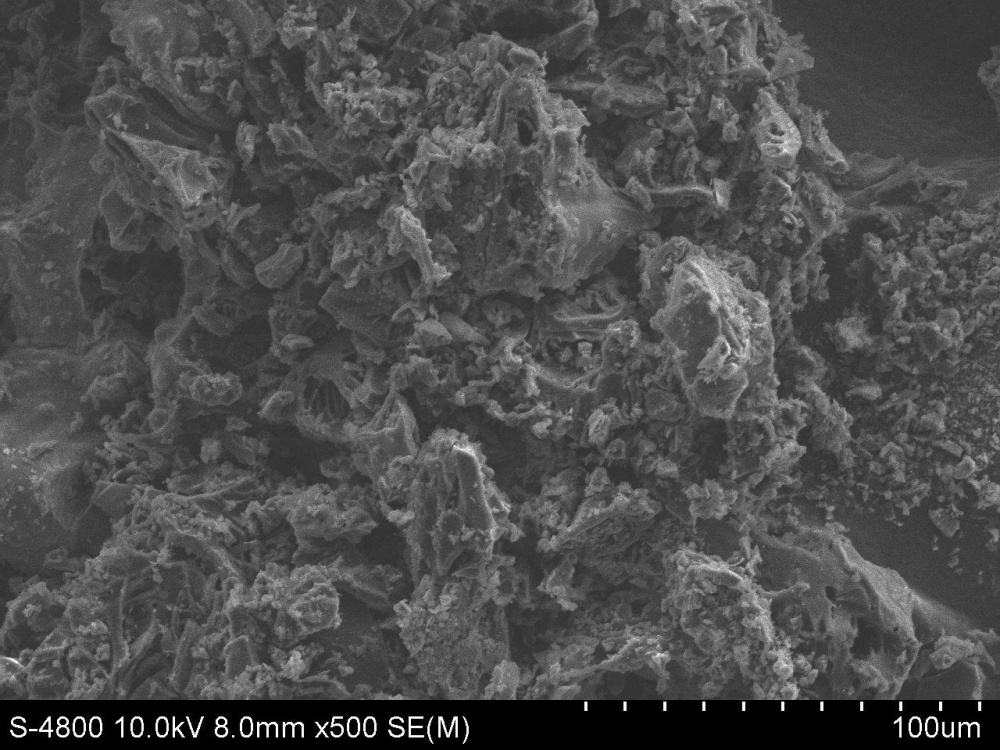
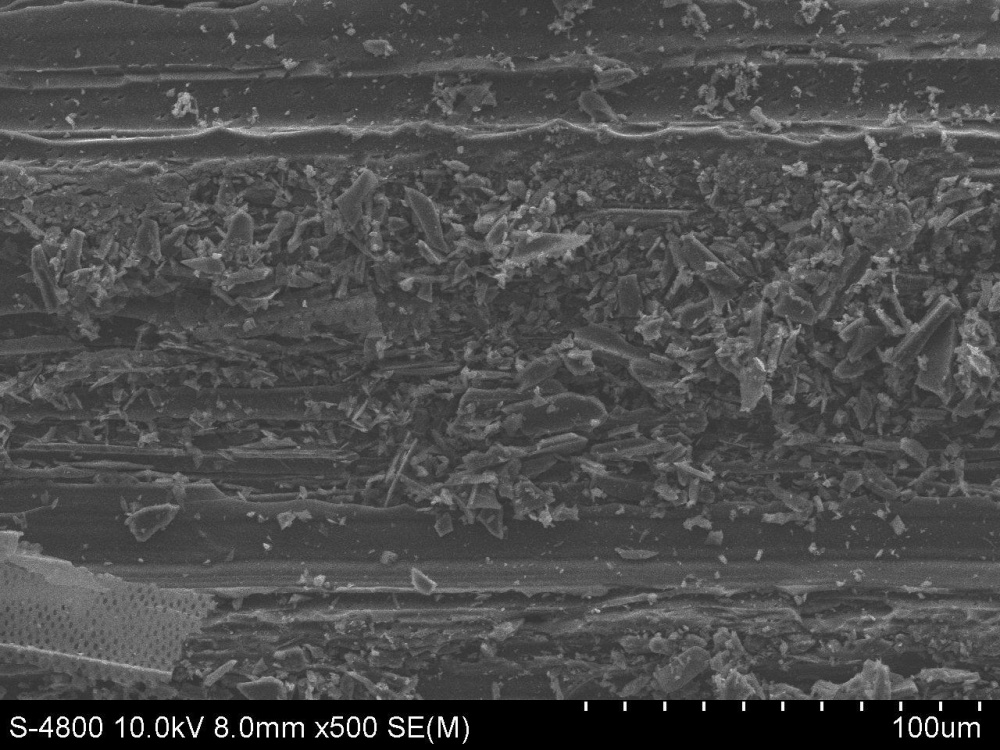
3.1. SEM characterization
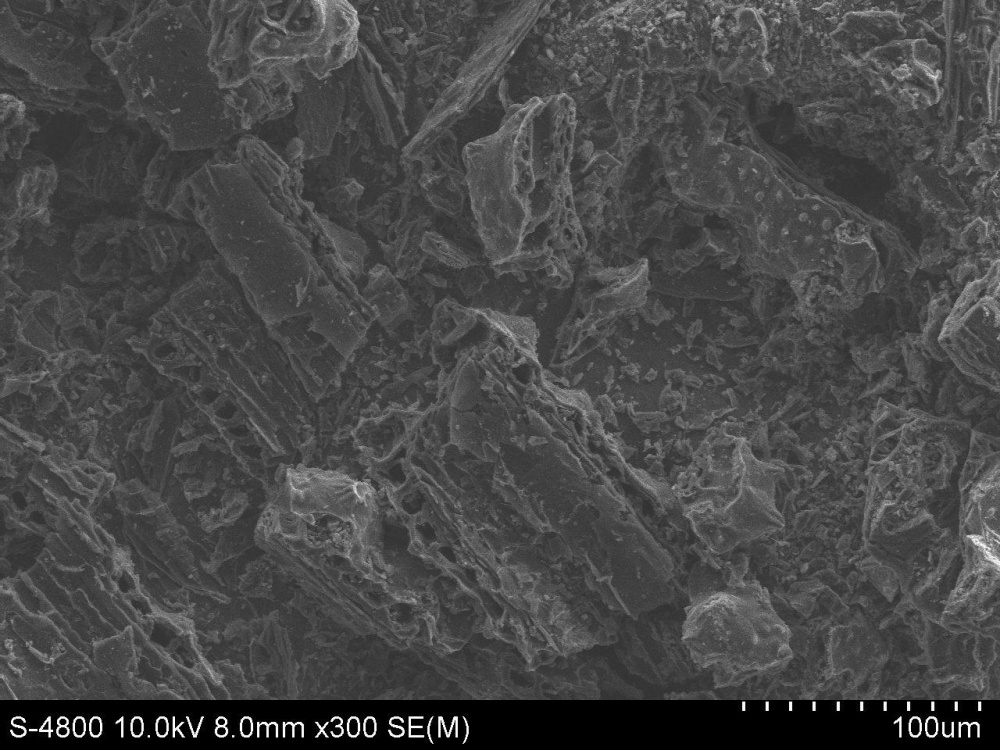
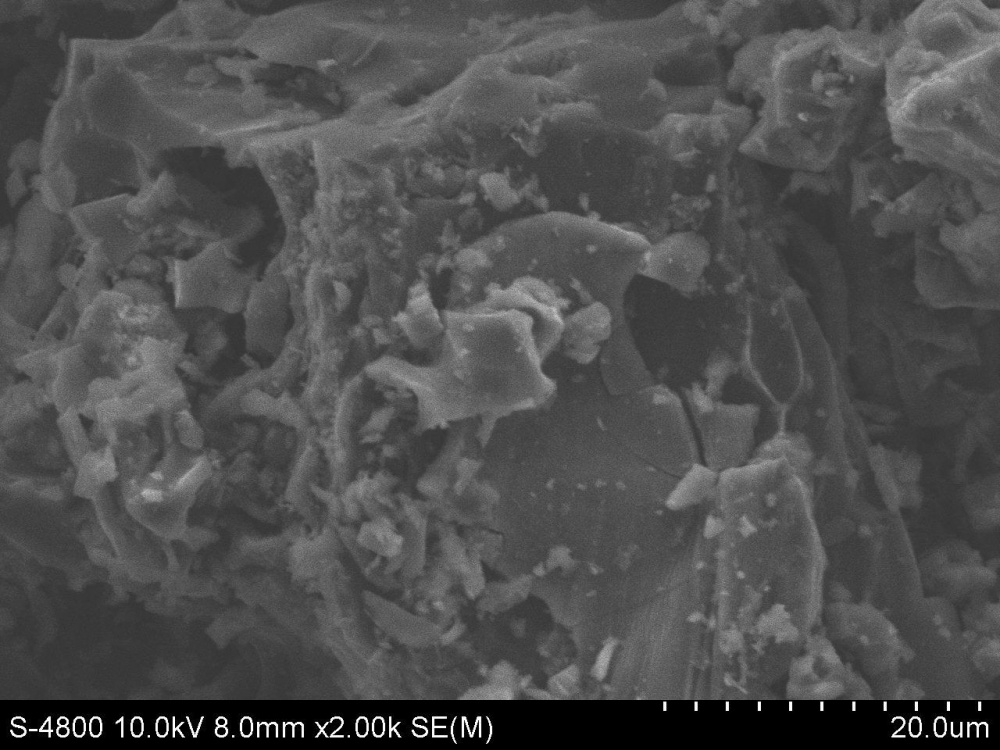
The feedstocks were crushed, screened, and dried, then compacted before carbonization figure 1. The resulting chars were chemically activated, washed or adjusted to neutral pH, dried again, and preserved for subsequent experiments. The final products were coded RH1 and RH2 for the rice-husk-derived biochars and SG1 and SG2 for the sugarcane-bagasse-derived biochars.
Figure 1. SEM micrograph of charcoal RH before (a) and after activated (b); charcoal SG before (c) and after activated (d)
|
(a) |
(b) |
|
(c) |
(d) |
3.2. Adsorption of crystal violet
The effect of pH showed that CV adsorption depended strongly on both the feedstock and the modified sample code. For the rice-husk-derived biochars, adsorption capacity increased from acidic conditions to a maximum around pH 6-7, with RH2 reaching approximately 4.0 mg/g and outperforming RH1. This trend is consistent with reduced competition from H⁺ ions and more favorable electrostatic interaction between the cationic dye and the deprotonated biochar surface at moderately acidic to neutral pH. For the bagasse-derived samples, SG1 maintained a relatively high adsorption capacity across the examined pH range and increased slightly toward alkaline conditions, whereas SG2 exhibited much lower unit adsorption capacity despite achieving high removal efficiency at suitable doses.
Increasing the adsorbent dose improved the percentage removal of CV for most materials because more active sites became available in the system. However, the adsorption capacity per unit mass decreased with increasing dose, which is a typical result of unsaturated adsorption sites and particle aggregation at high solid loading. Contact-time plots show a rapid initial adsorption stage followed by a slower approach to equilibrium. Depending on the material, equilibrium was largely approached within about 90-180 min. The temperature and initial-concentration plots indicate that adsorption capacity increased as the initial CV concentration rose and was generally favored at elevated temperature, especially for SG-based materials, suggesting improved mass transfer and possibly endothermic behavior.
Table 1. Kinetic parameters for crystal violet adsorption
|
Material |
k₁ |
qₑ,calc (PFO) |
R² (PFO) |
qₑ,calc (PSO) |
k₂ |
R² (PSO) |
qₑ,exp |
|
RH1 |
0.0051 |
2.6324 |
0.8769 |
1.0352 |
14.6067 |
0.9971 |
0.9611 |
|
RH2 |
0.0435 |
0.8676 |
0.9932 |
1.5378 |
0.2686 |
0.9937 |
1.4708 |
|
SG1 |
0.0039 |
2.5538 |
0.9252 |
1.8474 |
0.4544 |
0.9997 |
1.8276 |
|
SG2 |
0.0095 |
1.2791 |
0.9833 |
2.3613 |
0.1223 |
0.9998 |
2.3212 |
The kinetic parameters summarized in Table 1 show that the pseudo-second-order model provided a better fit than the pseudo-first-order model for all CV adsorption systems. The R² values for the pseudo-second-order model ranged from 0.9937 to 0.9998, while the calculated qₑ values were also much closer to the experimental values. This finding suggests that surface interactions and site availability played an important role in the adsorption process. The agreement was especially strong for SG1 and SG2, for which the pseudo-second-order model yielded R² values above 0.999.
3.3. Adsorption of Pb(II)
For Pb(II) adsorption, all materials displayed appreciable capacity across the examined pH range. RH2 reached its highest adsorption capacity near pH 6, while RH1 showed a broader plateau from mildly acidic to near-neutral conditions. The SG materials also performed well and maintained q values above about 10 mg/g over most of the tested pH range. At higher pH, apparent Pb(II) removal should be interpreted carefully because partial metal hydrolysis or precipitation may contribute in addition to adsorption.
The effect of adsorbent dose was more pronounced for the RH materials than for the SG materials when removal efficiency was considered. RH1 increased from roughly 30% to more than 80% removal as the dose rose from 1 to 15 g/L, while RH2 reached nearly complete removal at around 10 g/L. In contrast, the SG materials already showed very high Pb(II) removal efficiency even at low dose, with only slight changes at higher solid loading. As in the CV system, adsorption capacity per unit mass decreased as the dose increased. Contact-time curves showed that Pb(II) adsorption was rapid, with much of the uptake occurring during the first 10-30 min and equilibrium being approached within about 30-90 min. The SG materials exhibited higher equilibrium q values than the RH materials under the tested conditions. Temperature and initial-concentration plots indicated that qₑ increased with increasing C₀ and was slightly higher at elevated temperature, particularly at 45°C.
Table 2. Kinetic parameters for Pb(II) adsorption
|
Material |
k₁ |
qₑ,calc (PFO) |
R² (PFO) |
qₑ,calc (PSO) |
k₂ |
R² (PSO) |
qₑ,exp |
|
RH1 |
0.0005 |
31.9413 |
0.8998 |
2.3321 |
0.1735 |
0.9997 |
2.2955 |
|
RH2 |
0.0012 |
0.0283 |
0.8714 |
2.3946 |
0.1483 |
0.9999 |
2.3849 |
|
SG1 |
0.0501 |
1.1333 |
0.9791 |
4.4603 |
0.0053 |
1.0000 |
4.4331 |
|
SG2 |
0.0541 |
1.2649 |
0.9713 |
4.0112 |
0.0080 |
0.9999 |
3.9088 |
Table 2 demonstrates even more clearly that Pb(II) adsorption followed the pseudo-second-order model. For all four materials, the pseudo-second-order model yielded R² values between 0.9997 and 1.0000, and the calculated qₑ values agreed very closely with the experimental values. In contrast, the pseudo-first-order model produced substantially poorer fits and unrealistic calculated capacities for some materials. These results indicate that the adsorption of Pb(II) onto the modified biochars was governed primarily by surface-controlled interactions rather than by simple first-order mass transfer alone.
4. Conclusions
Modified biochars prepared from rice husk and sugarcane bagasse showed promising performance for the removal of both crystal violet and Pb(II) from aqueous solution. FTIR and SEM observations suggest that chemical activation improved the surface characteristics of the adsorbents and promoted pollutant binding. The adsorption behavior of both contaminants was strongly affected by pH, adsorbent dose, contact time, temperature, and initial concentration. For CV, RH2 and SG1 were the most effective representatives of the rice-husk and bagasse groups, respectively. For Pb(II), SG-derived biochars showed particularly high removal efficiencies, while RH2 also performed strongly under optimized conditions. In both systems, increasing dosage improved overall removal efficiency but lowered the adsorption capacity expressed on a mass basis. Kinetic analysis confirmed that the pseudo-second-order model provided the best description of the experimental data, especially for Pb(II). Overall, the study highlights the potential of agricultural-waste-derived biochar as a low-cost and sustainable adsorbent for wastewater treatment.
Acknowledgment:
The author would like to greatly acknowledge the support of time and facilities from the Ho Chi Minh City University of Technology, Ho Chi Minh City, Vietnam; Vietnam National University Ho Chi Minh City, Ho Chi Minh City, Vietnam for this study.
References:
Ahmad M., Rajapaksha A. U., Lim J. E., Zhang M., Bolan N., Mohan D., Vithanage M., Lee S. S., & Ok Y. S. (2014). Biochar as a sorbent for contaminant management in soil and water: A review. Chemosphere, 99, 19-33. https://doi.org/10.1016/j.chemosphere.2013.10.071.
Foo K. Y., & Hameed B. H. (2010). Insights into the modeling of adsorption isotherm systems. Chemical Engineering Journal, 156(1), 2-10. https://doi.org/10.1016/j.cej.2009.09.013.
Forgacs E., Cserháti T., & Oros G. (2004). Removal of synthetic dyes from wastewaters: A review. Environment International, 30(7), 953-971. https://doi.org/10.1016/j.envint.2004.02.001.
Ho Y. S., & McKay G. (1999). Pseudo-second order model for sorption processes. Process Biochemistry, 34(5), 451-465. https://doi.org/10.1016/S0032-9592(98)00112-5.
Lellis B., Favaro-Polonio C. Z., Pamphile J. A., & Polonio J. C. (2019). Effects of textile dyes on health and the environment and bioremediation potential of living organisms. Biotechnology Research and Innovation, 3, 275-290. https://doi.org/10.1016/j.biori.2019.09.001.
Liu Z., & Zhang F. S. (2009). Removal of lead from water using biochars prepared from hydrothermal liquefaction of biomass. Journal of Hazardous Materials, 167(1-3), 933-939. https://doi.org/10.1016/j.jhazmat.2009.01.085.
Mohan D., Sarswat A., Ok Y. S., & Pittman C. U., Jr. (2014). Organic and inorganic contaminants removal from water with biochar, a renewable, low-cost and sustainable adsorbent: A critical review. Bioresource Technology, 160, 191-202. https://doi.org/10.1016/j.biortech.2014.01.120.
Robinson T., McMullan G., Marchant R., & Nigam P. (2001). Remediation of dyes in textile effluent: A critical review on current treatment technologies with a proposed alternative. Bioresource Technology, 77(3), 247-255. https://doi.org/10.1016/S0960-8524(00)00080-8.
Điều chế và ứng dụng than sinh học biến tính từ vỏ trấu và bã mía để loại bỏ tím tinh thể và Pb(II)
Đặng Viết Hùng1
1Khoa Môi trường và Tài nguyên, Trường Đại học Bách khoa
2Đại học Quốc gia Thành phố Hồ Chí Minh
TÓM TẮT:
Nghiên cứu tập trung điều chế và ứng dụng than sinh học biến tính từ trấu và bã mía để xử lý màu Crystal Violet (CV) và ion Pb(II) trong dung dịch. Bốn vật liệu hấp phụ được ký hiệu RH1, RH2, SG1 và SG2 được tạo thành thông qua quá trình cacbon hóa và hoạt hóa hóa học phụ phẩm nông nghiệp. Phân tích động học cho thấy mô hình giả bậc hai phù hợp với số liệu tốt hơn mô hình giả bậc nhất, đặc biệt đối với hệ Pb(II) (R² ≈ 0,9997-1,000). Kết quả FTIR và SEM cho thấy, quá trình hoạt hóa giúp bề mặt vật liệu trở nên không đồng nhất và xốp hơn, đồng thời các nhóm chức bề mặt có vai trò quan trọng trong quá trình liên kết chất ô nhiễm. Kết quả chứng minh than sinh học biến tính từ phụ phẩm nông nghiệp là vật liệu hấp phụ giá rẻ, có tiềm năng cho xử lý nước thải chứa đồng thời chất màu và kim loại nặng.
Từ khóa: than sinh học, trấu, bã mía, crystal violet, Pb(II), hấp phụ.