




Abstract:
Despite the rapid expansion of the fast-fashion sector, maintaining brand loyalty among Generation Z remains a significant challenge. This study investigates the determinants of Gen Z’s repurchase intention toward Uniqlo in Ho Chi Minh City by employing an extended Theory of Planned Behavior (TPB) model that integrates Brand Trust, Timeliness, electronic Word-of-Mouth (eWOM), and Habit. Using a quantitative research design supported by expert validation, data were collected from 709 respondents. The results indicate that Habit is the strongest predictor of repurchase intention, followed by eWOM, Brand Trust, and Timeliness. These findings suggest that although Gen Z consumers are highly trend-oriented, habitual purchasing behavior plays a decisive role in shaping their repurchase decisions. The study underscores the importance for retailers to cultivate habit-forming customer experiences and enhance digital engagement strategies to foster long-term loyalty in the fast-fashion market.Keywords: repurchase intention, generation Z, extended TPB, fast fashion, habit.
1. Introduction
Fast fashion in Vietnam is increasingly shaped by Gen Z, especially in Ho Chi Minh City. Despite strong purchasing power, this group shows low loyalty and prioritizes experience (NielsenIQ, 2024), making repurchase intention vital for brands like Uniqlo, which grows through its LifeWear philosophy (Fast Retailing, 2025). Although TPB (Ajzen, 1991) provides a base framework, it may not fully explain Gen Z’s complex decisions. To address this, the study incorporates Brand Trust, Timeliness, eWOM, and Habit factors highlighted in recent research (Verplanken & Orbell, 2003; Limayem et al., 2007) to examine their influence on repurchase intention.
2. Literature review
Fast fashion has reshaped global consumption through accelerated product cycles (Bhardwaj & Fairhurst, 2010). In Vietnam, brands like Uniqlo have expanded significantly, influencing Generation Z, a strategic demographic representing nearly 23% of the population (DataReportal, 2025). While valuing sustainability, Vietnamese Gen Z displays a “say–do gap,” remaining receptive to fast fashion due to digital influence and transparency needs (NielsenIQ, 2024). To predict their behavior, this study utilizes the Theory of Planned Behavior (TPB) (Ajzen, 1991), extended to include brand trust, timeliness, electronic word of mouth (eWOM), and habit. These factors significantly shape repurchase intention by reducing perceived risk and providing social validation (Yoopetch, 2024; Vu & Nguyen, 2025). This theoretical foundation supports the modeling of Gen Z’s repurchase intention toward Uniqlo in Ho Chi Minh City.
3. Research methodology
This study used a quantitative design supported by expert consultations to validate measurement scales. Data were collected through a structured 5-point Likert online survey targeting Gen Z consumers in Ho Chi Minh City who had purchased Uniqlo in the past year. A total of 709 valid responses were analyzed using SPSS, employing Cronbach’s Alpha, EFA, correlation analysis, and Multiple Linear Regression to examine factors influencing repurchase intention.
Research result and discussion
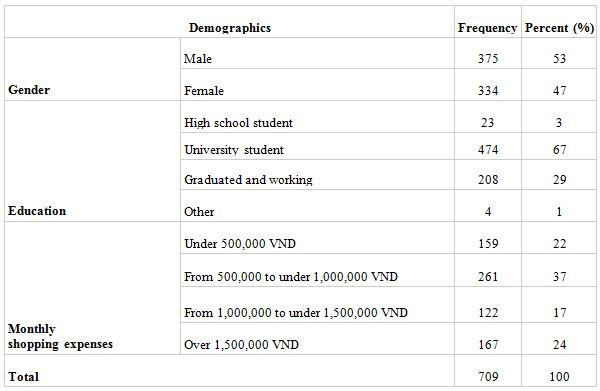
The demographic profile of the 709 valid respondents is summarized in Table 4.1. The sample demonstrates a relatively balanced gender distribution, with males accounting for 52.9% and females 47.1%. Regarding education, the majority are students (66.9%), reflecting the "Gen Z" target demographic. In terms of spending power, a significant portion of respondents (36.8%) allocate between 500,000 and 1,000,000 VND monthly for shopping, indicating a diverse range of financial capabilities consistent with the fast fashion market segment.
Table 1: Sample characteristics
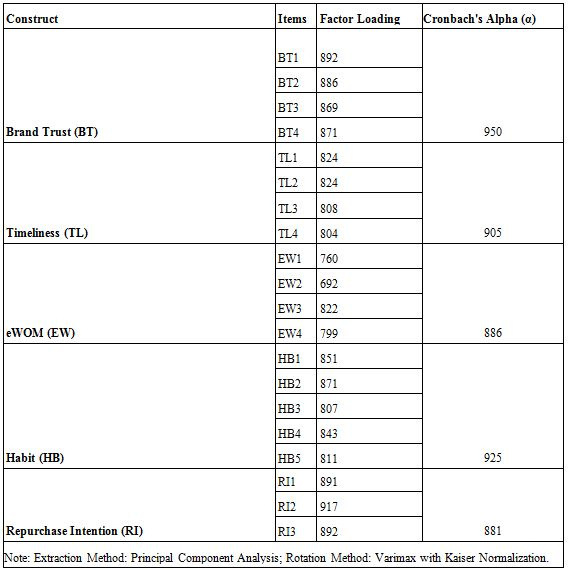
The measurement scales were rigorously tested for internal consistency and construct validity. As shown in Table 2, all constructs exhibited high reliability, with Cronbach’s Alpha coefficients ranging from 0.881 to 0.950, well above the recommended threshold of 0.6. Exploratory Factor Analysis (EFA) was conducted to assess the structural validity.
The Kaiser-Meyer-Olkin (KMO) measure was 0.918, and Bartlett’s Test of Sphericity was significant, confirming the suitability of the data for factor analysis. The analysis extracted four independent factors explaining 79.655% of the total variance. All observed variables possessed factor loadings exceeding 0.5, with no cross-loadings, demonstrating strong convergent and discriminant validity.
Table 2: Assessment of Reliability and Validity
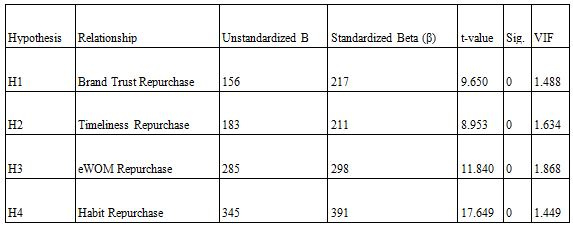
Multiple Linear Regression was employed to verify the research hypotheses. The model fit indicators were highly satisfactory, with an Adjusted of 0.760, implying that the four independent variables explain 76% of the variance in Repurchase Intention.
The F-test statistic was significant. Table 3 presents the regression results. The Variance Inflation Factor (VIF) values for all predictors ranged from 1.449 to 1.868 (< 2.0), indicating no multicollinearity issues. All four proposed hypotheses (H1, H2, H3, H4) were supported at the 95% confidence level (p < 0.05).
Specifically, Habit exerted the strongest influence on Repurchase Intention (beta = 0.391), followed by eWOM (beta = 0.298), Brand Trust (beta = 0.217), and Timeliness (beta = 0.211).
Table 3: Regression Analysis Results
5. Recommendation
Uniqlo should reinforce Habit through loyalty programs and consistent experiences, boost eWOM via micro-influencers and user-generated content, strengthen Brand Trust with transparent quality and sustainability communication, and improve Timeliness by optimizing logistics and service responsiveness to sustain Gen Z repurchase intention.
6. Conclusion
Validating an extended TPB model, this study identifies Habit (the strongest predictor), eWOM, Brand Trust, and Timeliness as key drivers of Gen Z’s repurchase intention. These findings underscore the critical role of automated behavior, suggesting that Uniqlo should focus on habit cultivation and digital engagement to sustain competitiveness (Ajzen, 1991).
The study’s main limitation is its cross-sectional design, which captures data at only one point in time. This restricts the ability to observe behavioral changes, meaning the findings reflect short-term repurchase tendencies rather than long-term shifts in Gen Z purchasing behavior or brand loyalty.
Acknowledgement:
The authors express sincere appreciation to FPT University for academic support and to all experts and survey participants for their valuable contributions.
References:
Ajzen I. (1991). The theory of planned behavior. Organizational Behavior and Human Decision Processes, 50(2), 179–211.
Ajzen I. (2002). Perceived behavioral control, self efficacy, locus of control, and the theory of planned behavior. Journal of Applied Social Psychology, 32(4), 665–683.
Bhardwaj V., & Fairhurst A. (2010). Fast fashion: response to changes in the fashion industry. The International Review of Retail, Distribution and Consumer Research, 20(1), 165–173.
DataReportal, We Are Social, Meltwater (2025). Digital 2025: Vietnam. Data Reportal. Retrieved November 1, 2025.
Hennig-Thurau T., Gwinner K. P., Walsh G., & Gremler D. D. (2004). Electronic word of mouth via consumer-opinion platforms: What motivates consumers to articulate themselves on the Internet? Journal of Interactive Marketing, 18(1), 38–52.
Limayem M., Hirt S. G., & Cheung C. M. K. (2007). How Habit Limits the Predictive Power of Intention: The Case of Information Systems Continuance. MIS Quarterly, 31(4), 705–737.
NielsenIQ & GfK (2024). Spend Z: Gen Z Changes Everything – Global Gen Z Spending Report.
Verplanken B., & Orbell S. (2003). Reflections on Past Behavior: A Self‐Report Index of Habit Strength 1. Journal of Applied Social Psychology, 33(6), 1313–1330.
Khám phá các yếu tố ảnh hưởng đến ý định mua lại của khách hàng Gen Z:
Nghiên cứu đối với thương hiệu Uniqlo tại TP.Hồ Chí Minh
Nguyễn Thành Vinh1
Đặng Tấn Tài1
Huỳnh Trần Khải Hoàn1
Trần Nguyên Khôi1
Du Đại Hiệp1
Trần Việt Hoàng1
Nguyễn Thị Thời1
Hồ Trà Giang1
1Trường Đại học FPT
TÓM TẮT:
Mặc dù ngành thời trang nhanh đang phát triển mạnh mẽ, việc duy trì lòng trung thành thương hiệu trong nhóm người tiêu dùng Thế hệ Z vẫn là một thách thức lớn. Nghiên cứu này khám phá các yếu tố ảnh hưởng đến ý định mua lại sản phẩm của Gen Z đối với thương hiệu Uniqlo tại TP. Hồ Chí Minh thông qua mô hình Lý thuyết Hành vi Dự định (TPB) mở rộng, kết hợp các biến: Niềm tin thương hiệu, Tính kịp thời, Truyền miệng điện tử (eWOM) và Thói quen. Sử dụng phương pháp định lượng có đối chiếu chuyên gia, dữ liệu được thu thập từ 709 người tham gia khảo sát. Kết quả cho thấy Thói quen là yếu tố dự báo mạnh nhất đối với ý định mua lại, tiếp theo là eWOM, Niềm tin thương hiệu và Tính kịp thời. Phát hiện này cho thấy mặc dù Gen Z có xu hướng chạy theo xu hướng mới, hành vi mang tính thói quen vẫn đóng vai trò then chốt trong quyết định mua lại. Nghiên cứu nhấn mạnh tầm quan trọng của việc xây dựng trải nghiệm mua sắm hình thành thói quen và tăng cường tương tác số nhằm giúp các nhà bán lẻ nuôi dưỡng lòng trung thành dài hạn trong thị trường thời trang nhanh.
Từ khóa: ý định mua lại, Thế hệ Z, mô hình Hành vi Dự định (TPB) mở rộng, thời trang nhanh, thói quen.